
How the Russian ideology of Anti-Turkic Expansion Was Shaped: The Lord “Shall Subjugate Them to Us as Well” (14th–16th Centuries)


“…At this time, the name of Jerusalem must belong to Moscow, since the old Jerusalem has become worthless, having been in the power of the impious Saracens [Muslims] for many years”[422] (a view commonly expressed by Moscow’s clerical and intellectual elite, 1520s)
The central tenets of Moscow’s ideology of expansion into the Caucasus, present-day Ukraine, Moldova, Belarus, and other Eastern European countries were shaped as early as in the 14th–16th centuries. They were grounded in the idea of Moscow’s messianic mission as the “God-protected city.” Moscow positioned itself as the successor to Byzantine Constantinople—as the center of Rus' lands and, more broadly, of all lands, where Eastern Christianity was the predominant religion and as the universal patron of Orthodoxy. This doctrine rested on the cultivation of a hostile image of Turkic Islam. Assertion of Christian supremacy over Islam through imperialist expansion was proclaimed as the sacred duty of Moscow’s rulers.
- From the late 14th century onward, the idea of Moscow’s leadership in consolidating East Slavic lands was evolving in close alignment with the doctrine of an almost sacred religious conflict with Turkic Muslims, seen as agents of Satan’s will.
- Following a major confrontation with the Tatars in 1480, which ended successfully for the Muscovites, a new image of Moscow as the center of the entire Orthodox world began to take shape. At the same time, the prospects of expansion into the Turkic world were articulated for the first time: God “shall subjugate them to us.”
- In the late 17th century, the protection of Christian interests in the Muslim East, including the Caucasus, became one of the key motives for Moscow’s expansion beyond the existing borders.
From the 16th century onward, the Tsardom of Moscow and, subsequently, the Russian Empire positioned itself as the patron, protector, and “liberator of Christian peoples”[424] in the Muslim East[425] . According to a Russian government document on Armenian policy, “Russia, pursuing the aim of weakening the Ottoman power and thus supporting Christians in their struggle for independence, acquired a reputation of a liberator in the eyes of the Eastern Christians”.[426] This became both an ideological justification and a political pretext for the Russian expansion[427] , which was frequently perceived as a form of Crusade[428] .
Following a major confrontation with the Tatars in 1480, which ended successfully for the Muscovites, a new image of Moscow as the center of the entire Orthodox world began to take shape. At the same time, the prospects of expansion into the Turkic world were articulated for the first time: God “shall subjugate them to us.”
In the late 17th century, the protection of Christian interests in the Muslim East, including the Caucasus, became one of the key motives for Moscow’s expansion beyond the existing borders.
How the Image of the Turkic-Muslim Enemy Was Developed as the Basis for Moscow’s Expansionist Ideology
In the earliest references to the Mongol-Tatars in Russian chronicles of the late 13th and early 14th centuries[433] , they are portrayed in negative[434] , sometimes mildly unfavorable terms[435] , with an emphasis on their behavioral and linguistic otherness[436] . Although the chroniclers mentioned “lawless Ishmaelites”[437] (Muslims) among these outsiders, for the most part they described them as “pagans”[438] or “godless”[439] heathens. They wrote about their pagan rites[440] , magi (priests)[441] , and deities[442] . At the same time, the chroniclers stated that the authority of the khans was granted by God[443] and, in some cases, even sought to portray them more favorably[444] .
In the 1320s[445] , the tone changed. The chroniclers presented Uzbeg Khan in an extremely negative light[446] and emphasized that he had adopted “the God-detested Saracen [Muslim] faith.”[447] The image of a religious enemy emerged.[448] From then on, people of the Golden Horde were described as instruments of the devil’s will[449] , actively doing harm to Christians[450] . (The satanic image of Muslims remained deeply rooted in Russian perception for a long time: an influential 16th-century theologian spoke of “diabolical teachings of the godless Hagarenes[451] ,” and in folklore, a “basurman” [also “busurman,” “besermen,” “basurmanin,” i.e., a follower of Islam] embodied demonic power: “A busurman, sorcerer, black magician, and villain; he keeps company with the devil, and never goes to God’s church.[452] ”)
In the late 14th and early 15th centuries, the perception of the Tatars by Russian chroniclers was transformed once again[453] . This happened after the first major victory over the Tatars under Moscow’s leadership (1380) and amid Tamerlane’s devastating campaigns against the Golden Horde (1395–1396). The scribes increasingly emphasized the Tatars’ religious affiliation, portraying it in a particularly negative light. They called them “sons of Hagarenes[454] ” (deriving the name from that of the Hagar—the mother of Ishmael, considered to be the forefather of all Arabs), “pagan Ishmaelites[455] ,” “impious offspring of Ishmael[456] ”, “evil revilers of Christians[457] ,”“busurmans”,[458] and “pagan Tatar busurmans”.[459]
The Tatars were now portrayed in an entirely negative light, as enemies of Orthodoxy[460] who sought to“exterminate Christianity”[461] and were guided bythe devil[462] . A stark contrast was drawn[463] between Russian “faithful people”[464] and “infidel busurmans[465] ,” and their resp[466] ective worlds — “the Rus' land” and “the Tatar land,”[467] “God has exalted the Rus' land, and shamed the godless Hagarenes.”[468] The scribes proclaimed the uncompromising struggle against Muslims as God’s work[469] “for the land of Rus' and for the Christian faith.”[470] It was perceived as the protection of Christianity[471] . Those who fell fighting Tatars were equated[472] with holy martyrs.
The Tatars were now portrayed in an entirely negative light, as enemies of Orthodoxy[460] who sought to “exterminate Christianity”[461] and were guided bythe devil[462] . A stark contrast was drawn[463] between Russian“faithful people”[464] and “infidel busurmans[465] ”, and their respective worlds[466] — “the Rus' land” and “the Tatar land,”[467] “God has exalted the Rus' land, and shamed the godless Hagarenes.”[468] The scribes proclaimed the uncompromising struggle against Muslims as God’s work[469] “for the land of Rus' and for the Christian faith.”[470] It was perceived as the protection of Christianity[471] . Those who fell fighting Tatars were equated[472] with holy martyrs.
The Ideological Legitimation of Moscow’s “Universal” Supremacy
The chronicles unequivocally represented the Grand Prince of Moscow as the leader of this struggle. They invariably portrayed him as a champion of “the holy churches,” “the true Christian faith,” and “the entire Rus' land.”[473] His virtues and royal qualities were idealized and overemphasized[474] in every possible way. The Moscow ruler was now depicted as the “Tsar of all the Rus' land”[475] and Moscow was proclaimed as a “God-protected city.”[476]
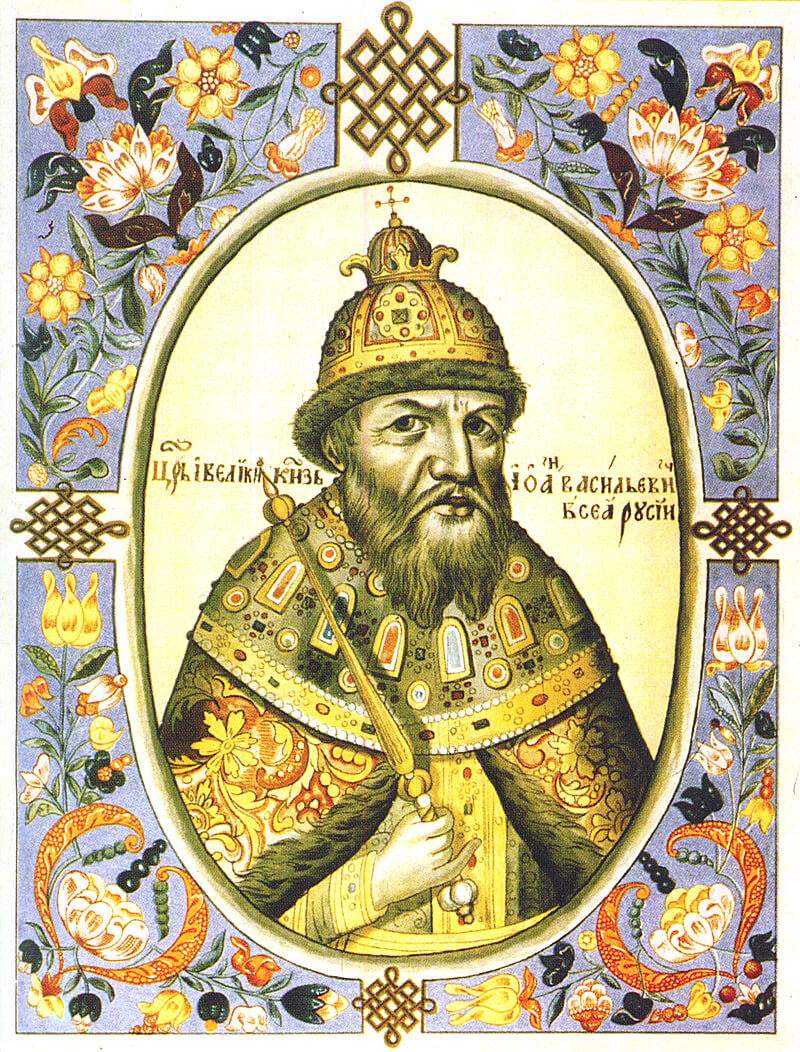
Ivan IV the Terrible. Portrait from the "Tsar's Book of Titles."
This was the justification for the Moscow principality’s leadership in confronting the weakening Golden Horde and its Turkic successors, as well as consolidating Rus' lands[477] . Church ideologists no longer saw these lands narrowly as just North-Eastern Rus', but rather in the broadest terms, as encompassing the territories of present-day Ukraine, Belarus, Moldova, and even Bulgaria[478] .
However, it was not the only project aimed at developing the Russian-Orthodox community in the 1380s–1410s. Alternative visions existed alongside the one constructed in Moscow. Some political forces and scholars advocated for consolidating historical Rus' lands under the leadership of other East Slavic centers, including those located in what is now Ukraine, particularly Kyiv[479] . Some Russians also supported further development under Tatar auspices[480] . In Moscow, they were scornfully called “a new Judas,” “champions of the besermen [Muslims],”[481] “Christian traitors,” and “henchmen of the besermen.”[482]
The Moscow church ideologists declared adherents of all other visions “enemies of the Cross.”[483] Consequently, serving Orthodoxy meant strictly adhering to the Moscow project.
The religious legitimation of Moscow’s supremacy served to justify the sacral status of its authorities and its exceptional role not only in consolidating Rus' lands but also in a broader territorial expansion. The dichotomy between the Moscow-led “true-believing Christians” and the “infidel Muslims” of the “Tatar land” ultimately ensured the legitimacy of expansion into the original Turkic-Muslim lands. Since the people of Rus' referred to all Turkic peoples (except for the Ottomans) as Tatars since the times of Genghis Khan, the scale of potential expansion “in the name of the Orthodox faith” was extremely broad, encompassing the Volga region, Siberia, Central Asia, and the Caucasus.
However, even that vast area did not limit these dizzying prospects. As early as the 1380s, one of the programmatic chronicles emphasized that the objective was to oppose not only the Tatars but also the Ottomans in the Balkans[484] . This signaled, for the first time, the potential for geopolitical rivalry with the Ottoman Empire, which dealt the Orthodox Bulgarians, Serbs[485] , and Byzantines one defeat after another in the 1350s–1390s.
In this context, it is revealing that Moscow’s relations with the Ecumenical Orthodox Patriarchate (the center) in Constantinople were steadily deteriorating[486] throughout the 1370s–1390s. The Grand Prince of Moscow and his ecclesiastical ideologists were no longer willing to submit in spiritual matters to the Byzantine Empire, which was weakening under the Ottoman onslaught. In 1448, the Russian Orthodox Church broke away from the authority of the Ecumenical Patriarch of Constantinople and became independent[487] . “After the fall of Byzantium [1453], the idea began to spread in the Moscow state that the light of Greek Orthodoxy was dimming…”[488] In the 1470s, “the famous formula on refusing to recognize metropolitans appointed in ‘Constantinople’ was introduced”[489] into the oath of the leaders of the Russian Orthodox Church.
If Moscow is a “God-protected city,” why should it not aspire to become the religious and political center of Orthodoxy? “…Nowadays, the name of Jerusalem must belong to Moscow, since the old Jerusalem has become worthless, having been in the power of the impious Saracens [Muslims] for many years,”[490] the Moscow ideologists believed. Besides, unlike the Byzantines, the Russians demonstrated the ability to effectively wage religious wars against followers of Islam[491] .
Following another major confrontation with a Tatar force in 1480, which ended successfully for the Muscovites, the new image of Moscow “as the center not only of the Rus' lands but also of the entire Orthodox world”[492] began to take shape. In this context, in 1480, the concept of the “God’s chosen Russian land” was reinforced, and Rus' was equated with “the new Israel.”[493] In 1495, “Russian ecclesiastical and secular authorities claimed succession to the customs and rights of the [Byzantine] Patriarchate.”[494] In 1497, the ruler of Muscovy first used the double-headed eagle—the Byzantine imperial symbol of power over East and West—on the state seal.
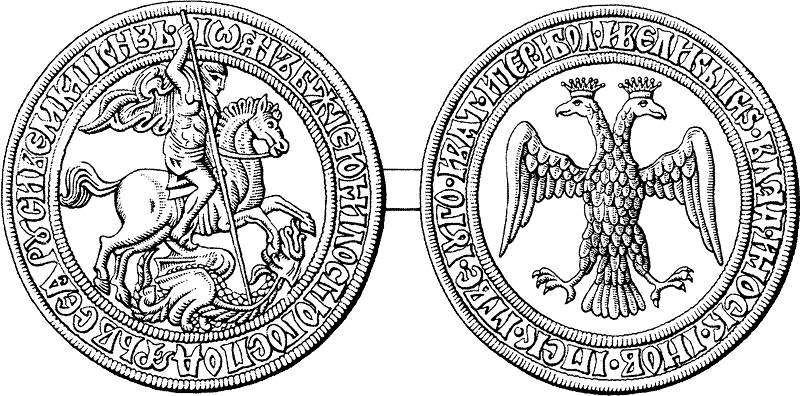
State Seal of Ivan III. Late 15th century.
This was an explicit claim to succeed to Constantinople’s “primacy among Orthodox Christians”[495] and its status as “the patron of Eastern Christianity.” In 1514, Philotheus, a monk from Pskov, in a message to the Grand Prince, developed the idea that “all Christian kingdoms… converged [united] in the Russian Tsardom, as two Romes fell, and the third one [Moscow] stands.”[496] Contemporary Russian researchers explain: “The Third Rome, or, in other words, the New Israel, was a state deeply religious at its core; it harbored the belief that it was possible to make the whole world Orthodox… After new territories were annexed, they were quickly ‘painted’ in the colors of Orthodoxy.”[497] Therefore, “a new ideology of the Russian state begins to take shape based on ideas of the messianic destiny of Rus' and the God-chosen power of the Grand Prince.”[498] An American researcher adds: “Russia has been imbued with its own messianic ideas since the late 15th century, and its expansionist ideology was fundamentally shaped by the confrontation with pagan and Muslim peoples to its south and east.”[499]
At the same time, the Moscow ruler was increasingly sacralized. Scribes proclaimed him the “shepherd”[500] and declared that the fight against the Tatars was his religious duty[501] . Moreover, he was no longer referred to by his official title of Grand Prince but rather as “the great Christian Tsar of Rus' lands[502] .” A distinguished clergyman portrayed the Moscow ruler not only as superior to the Tatar leader, but as “the most radiant and most glorious tsar among all tsars[503] .” This emphasis on supremacy over the “false” Tatar “Tsar” supported the claim to the establishment of the Russian tsardom.
How the Concept of Anti-Turkic Expansion Emerged
With the Grand Prince declared “the God-ordained Tsar[504] ,” the same ideological premises underpinned the concepts of holy war against the Turkic Muslims. As early as 1469, Metropolitan Philip I of Moscow and All Rus' justified the need for a more aggressive policy against the “godless Hagarenes” as follows: “for the holy churches of God and for Orthodox Christianity.”[505] Against the same background, in 1480, the prominent Rostov Archbishop Vassian Rylo first outlined the prospects of expansion against the Tatars: the Lord “shall subjugate them to us as well.[506] ” In 1523, Daniel, Metropolitan of Moscow and All Rus', effectively articulated the first objective, declaring: “the Grand Prince will take the entire land of Kazan.[507] ” In 1551, the influential theologian Maximus the Greek, who instructed Ivan the Terrible’s father and later Ivan himself, declared that the Almighty Himself had instilled in the heart of the Tsar of Muscovy the desire “to free the Christians forever from the besermen faith [Islam].[508] ”
In the 16th century, under Ivan the Terrible, the concept of great-power Orthodox expansion was developed further. Its main premise was the “protection” of Christianity[509] or, more precisely, the assertion of Orthodoxy’s supremacy over Islam through imperialist expansion. As the tsar himself put it, “manifesting to all that the Christians are victorious over the pagans.”[510]
In 1547, Macarius, Metropolitan of Moscow and All Rus', who exercised enormous influence over the young Ivan IV[511] , outlined the foreign policy program of his reign: to subjugate “all barbarian tongues [peoples].”[512] In turn, priest Sylvester, the spiritual advisor to the first Tsar of “all Rus',” instructed Ivan IV as follows: “All tsars of the Earth shall bow before thee [acknowledge your supremacy], and all tongues [all peoples] shall yield to thee.”[513] The goal was “to fill the entire universe with Orthodoxy.”[514]
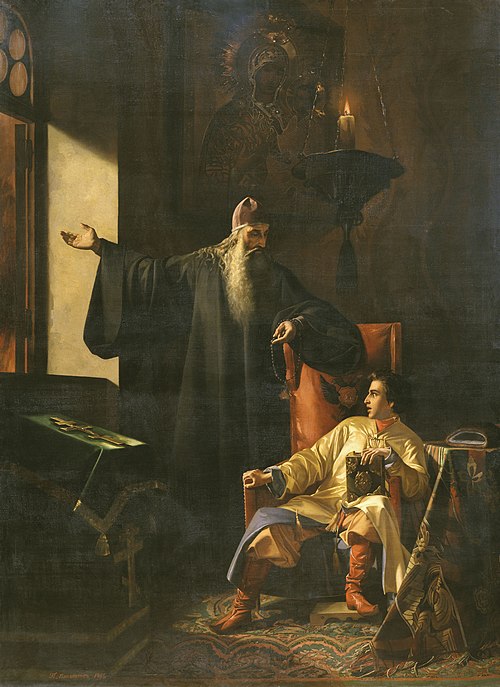
Priest Sylvester and Ivan the Terrible During the Moscow Fire of 1547, by P. Pleshanov.
These ideas were put into practice as soon as 1552, during the capture of Kazan, which was then a major Islamic center[515] . Once again, the leading figures of the Muscovite Orthodox clergy[516] played a special role in providing a rationale for this annexation. The tsar and his churchmen did their best to portray the battle for the city and the Russian victory as a triumph of Christianity over Islam. “They accomplished this feat to defend Christianity from Islam… Here, Central Asia, under the banner of Muhammad, fought for its last stronghold against Europe that marched under the Christian banner of the sovereign of Moscow,”[517] remarked the eminent Russian historian Sergey Solovyov, the founder of the statist school in Russian historiography. On his way to Kazan, Ivan IV stopped to worship tombs of Christian saints. Miracle-working icons[518] were carried with the Russian army, and religious symbols adorned[519] its banners. To “strengthen” the siege of the city, a “Holy Cross[520] containing a fragment of the True Cross was brought. The assault was scheduled on an Orthodox holiday[521] . During the fierce fighting, the Tsar and his churchmen did not interrupt the religious service[522] . After the resistance had been suppressed, Ivan IV held a solemn prayer service, “led a procession with crosses around the city walls,” and the military leaders and nobles chanted[523] that the tsardom of Kazan had been granted to him by God. They also proclaimed: “You are our God-given defender against the godless Hagarenes; through you, the poor Christians are now freed forever, and the unholy place [Islamic Kazan] is illuminated by grace [with 190,000 inhabitants killed].”[524] Ivan IV declared that the conquered and destroyed city would henceforth be an Orthodox city[525] . Moreover, in modern terms, the Tsar spoke of the defeated Kazan as follows: “Those who once heard and saw abominations and desolation in the city of Kazan, and saw barbaric mosques there, now see God’s churches, Christian churches, in the same places.”[526] The monarch of Muscovy personally baptized two captured Kazan khans[527] . “…In the eyes of contemporaries, the conquest of Kazan was, first and foremost, a feat of piety, and a victory of Orthodoxy.[528] ”
In the late 16th century, during the reign of Ivan the Terrible’s son, this concept of expansion was extended to the Caucasus region[529] . The desire to support fellow believers and strengthen Orthodoxy among them[530] provided justification for aiding the kings of Georgia and carrying out the first Russian invasions into Dagestan. The envoys of Muscovy assured the Georgian king that the aim of the Russian monarch was “to liberate Christians and defeat Muslims[531] .”
At the beginning of the 15th century, the ruler of Muscovy extended his protection to Orthodox monasteries[532] in lands under the Ottoman control. Even then, this created a sense of “anti-Ottoman stance of Russian foreign policy, at least in the matters of religion.[533] ” Beginning in the 1670s–1690s, protection of Christians’ interests in the Ottoman Empire[534] and even their liberation “from pagan tyranny” were among the key declared goals of Moscow’s eastern policy.
From the early 18th century, the same concept served to legitimize Russia’s ambitions to subjugate South Caucasus, including the Erivan Khanate[535] . It enabled[536] Russian agents operating in the Caucasus, Persia, and Turkey to effectively mobilize Armenians against their Muslim rulers, turning them into the “fifth column.” “The tsars immediately recognized the potential role of Armenians as instruments of Russian influence in the Middle East. In their expansionist plans, they intended to rely on the help and sympathy of the Armenians as their fellow Christians.”[537] As a result, Armenians became “the most important factor in strengthening and consolidating Russian influence in Muslim countries in general, and in the Caucasus in particular.”[538] The foundation for this strategic partnership had been laid long before the conquest of the Erivan Khanate.