
How the Great Uzbeg Brought Muscovy into Being to the Ruin of the Turkic Peoples (1243–1696)


«Moscow owes its greatness to the khans»[1] (Nikolay Karamzin, a founder of Russian historiography, 1821).
Moscow, a small provincial town, was first mentioned in chronicles 90 years before the beginning of the Mongol-Tatar rule in Eastern Europe. Yet, just 127 years after ceasing to pay tribute to the Tatars, Moscow subjugated 14 Turkic states, including almost the entire South Caucasus, notably the Erivan Khanate. Moscow owed its astonishing rise to Uzbeg Khan. Fifteen years after the death of his son and successor, Moscow began its advance into the Muslim East. The notorious Ivan the Terrible, whose ancestors had faithfully served Uzbeg Khan, reproduced the practices of this Turkic ruler in terms of state building and external expansion, thus beginning the struggle for his legacy. This laid the foundations of Moscow’s imperial ideology and eastern policy for centuries to come. The instant that Ivan the Terrible, the first tsar of Muscovy, was crowned, the fate of the Turkic peoples of Erivan and Zangezur was predetermined.
- Uzbeg Khan’s religious policy had far-reaching consequences for the formation of Muscovite-Russian imperial ideology. Following his conversion to the Muslim faith, the Russian intellectual elite came to see Orthodox Christianity and Islam as opposites. Subsequently, the protection of Christianity in Muslim lands became perhaps the main justification for the southward expansion of the Russian Empire, including into the Caucasus.
- Russia made most of its territorial acquisitions in the 17th–19th centuries within the former domains of Uzbeg Khan. This applies to North Caucasus, the territories of present-day Ukraine, Moldova, Kazakhstan, Uzbekistan, Turkmenistan, and Azerbaijan.
- The first attempt by Ivan the Terrible to capture Kazan in 1549 and the occupation of this major Islamic center in 1552 serve as the starting points of Moscow’s imperialist expansion into the vast expanses of the Muslim East.
Members of the Armenian minority enjoyed a privileged position at the courts of the Erivan Khanate’s rulers, in Persia and the Ottoman Empire, especially as trade agents. Erivan rulers patronized the Armenian Church.[20] In 1723, a French missionary noted that, despite their small numbers, Armenians had four churches in Erivan[21] . The Ottomans[22] , who temporarilycaptured the city[23] in September 1724, showed similar religious tolerance toward them. The Armenian Catholicos noted at the time: from them we, Christians, have great honor and peace, and no offense whatsoever…[24] According to a 1781 report by the Russian ambassador in Istanbul, the Ottoman authorities patronized and protected the Armenian Church[25] .
However, this peaceful coexistence began to crumble[26] as soon as the Russian Empire made its very first attempts to expand into the Caucasus, actively assisted by the local Armenian minority.
The Golden Horde Heritage: Islam, Turkism, and Moscow
Moscow’s expansion into the Muslim East began in 1372, and from 1549 onwards, it took on an explicitly imperialistic character[27] . After Russia took Erivan in 1827, the number of Turkic-Muslim state entities it seized and eliminated reached 14: three in the Volga region, one in Siberia, and ten in the Caucasus.
However, just a short time before this rapid advance to the east and south, Moscow had been merely part of an ulus[28] (administrative and territorial unit) of a vast Turkic-Muslim empire. Tatars lived in the Moscow Kremlin[29] . The townspeople’s aesthetic tastes were largely shaped by Islamic canons[30] . Many items of clothing and weaponry, along with their names, were borrowed from Turkic cultures[31] . The coins minted in Moscow bore Arabic inscriptions—remarkably, without mistakes—and the khans’ names[32] ;and prayers for the khans’ health were offered[33] in local churches. Icons, helmets, and armor were adorned with inscriptions invoking the name of “Allah”[34] . Eastern cultural influence was so strong that ultimately, one-fifth of Russian vocabulary came to be of Turkic origin[35] . In the 1520s, the ruler of Muscovy even seriously considered appointing a Turkic prince as his successor[36] . Moreover, it was only in 1700 that the Tsardom of Moscow officially stopped[37] paying tribute to the Crimean Tatars. However, just 127 years later, the capture of Erivan brought the Russian conquest of the South Caucasus almost to completion.
How did it happen that a small[38] border[39] fortress town[40] lost somewhere deep in the forest[41] built according to Polish architectural designs by craftsmen from what is now Ukraine[42] and first mentioned briefly[43] in the chronicles 90 years before the Tatar rule began, managed to subjugate the entire Turkic Eurasia? In short, Turkic peoples themselves played a significant role in the rise of Muscovy. As the Kazakhstani scholar Sultan Akimbekov, a meticulous researcher, observes, “Without the Tatar legacy, there would be no Russia”.[44]
If we are to examine this paradox in more detail, we should at least briefly review the key milestones of Turkic–Russian relations in the 13th–16th centuries. It is this interethnic interaction that gave rise to the Russian imperial statehood and its great-power ideology, which included as one of its core components expansion into the Muslim East in interaction with local Christian peoples, particularly Armenians.
In the late 1250s–1260s[45] , the largest continental empire[46] in human history, created by Genghis Khan, broke apart. In the western part of the empire, a state officially named “the Ulus of Jochi[47] ” emerged, which later became widely known as “the Golden Horde[48] .” It was predominantly Turkic[49] . The Turkic-speaking population came to be collectively known as 'Tatars,' after the most well-known Turkic tribe of the time[50] . Mongols constituted an insignificant minority[51] , and by the mid-14th century, they had been almost completely assimilated[52] .
Its area was enormous[53] —it was the largest state in medieval Eurasia[54] . Its armies came as far as Poland[55] and Hungary[56] . In the 13th century and the first half of the 14th century, the power of the khans extended over territories that today include almost all of Kazakhstan, the northern regions of Kyrgyzstan and Turkmenistan, part of Uzbekistan and Azerbaijan, vast areas of North Caucasus, western regions of Russia, Tatarstan, Chuvashia, Mordovia, Western and Southern Siberia, almost all of Ukraine, Moldova, southern Romania, and parts of Bulgaria and Serbia[57] . It was the last Turkic state where ancestors of the major modern Turkic-speaking peoples—Azerbaijanis, Kazakhs, Uzbeks, Turkmens, Kazan Tatars, and Bashkirs—shared the same territory.
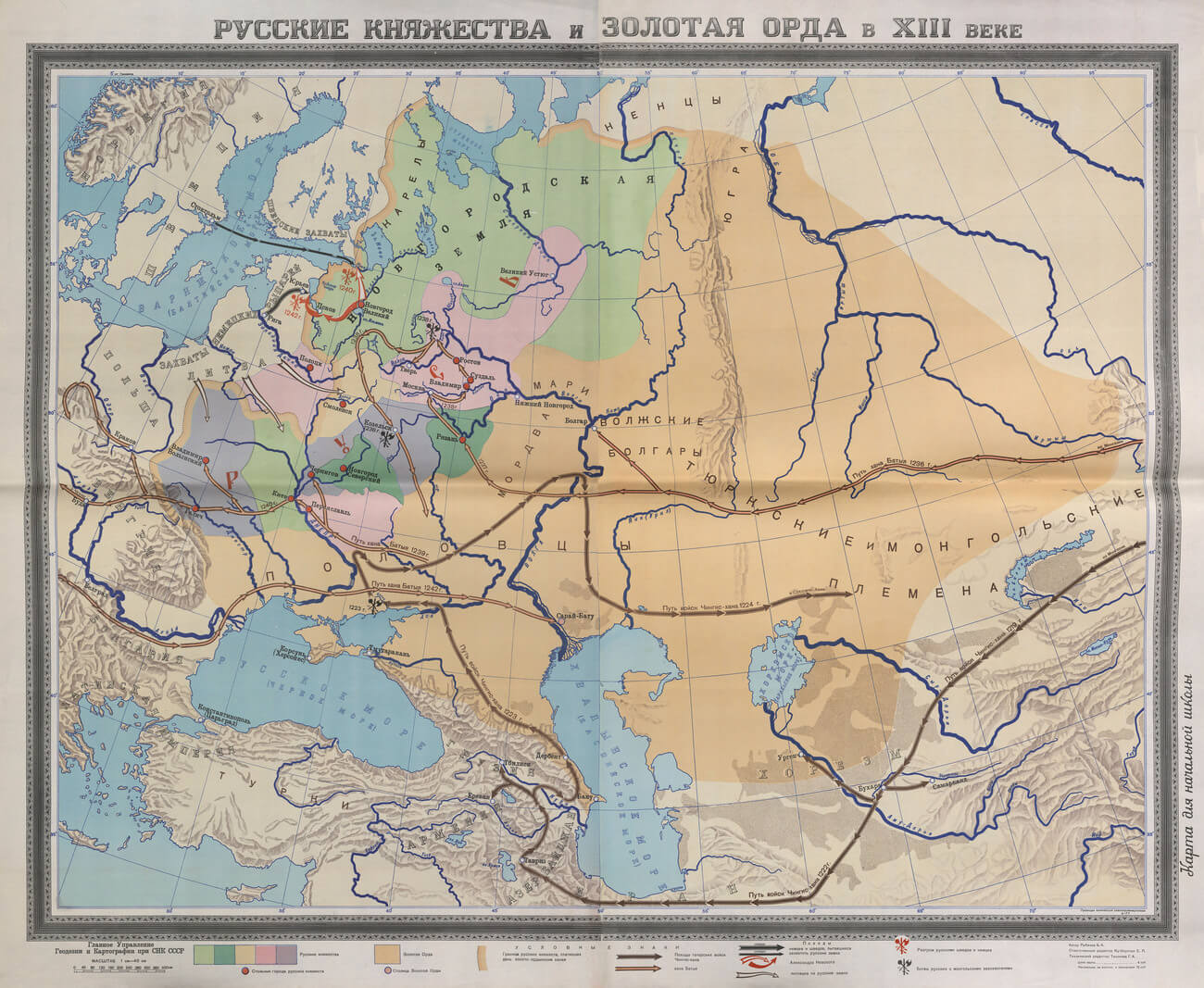
Map of Russian Principalities and the Golden Horde in the 13th Century, by B.A. Rybakov.
At that time, western parts of modern-day Russia belonged to the historical region known as “North-Eastern Rus'.” They were split into about two dozen[58] semi-autonomous territories—principalities[59] . The princes who ruled them were subject to the khans’ authority from the 1240s onward[60] . The Rus' scribes who produced their writings in various principalities believed that the khan’s power was granted by God[61] . As such, it was absolutely legitimate[62] and had to be obeyed[63] unconditionally; moreover, such obedience was even seen as honorable[64] . The Golden Horde suzerain was reverentially referred to as “caesar[65] ” or “tsar[66] ”—the imperial title previously applied by East Slavs only to the rulers of the Byzantine and the Holy Roman Empires[67] .
The princes feuded with one another fiercely[68] , at times even directly in the khan’s headquarters, struggling for dominance in North-Eastern Rus' and, most importantly, for the right to collect taxes from their fellow countrymen[69] on behalf of the Mongol-Tatar ruler[70] (the so-called “vykhod,” referred to as “tsar’s levy” in Rus' chronicles and described as “tribute” by modern historians[71] ). This rivalry manifested both in local clashes between principalities and the frequent attempts by the princes to discredit one another[72] before the khan and his close circle, bribery[73] of the Golden Horde officials, and devious scheming[74] in the imperial capital. The discredited rivals lost their privileged status and often their heads[75] as well.
In the pre-Mongol era, Moscow “did not play any significant role in the life of North-Eastern Rus'.[76] ” Unlike Kyiv, it was neither a major city in the early Rus' state[77] nor a leading clerical center[78] . Small and weak[79] , the Moscow principality that was established in 1282 (1293)[80] , initially was not among the developed Rus' territories[81] . “Muscovite Rus' was a small, poor, and sparsely populated country.”[82] Nothing seemed to foreshadow[83] its future rapid rise.
It was not before the end of the 1290s that the khan’s strategists began to use Moscow as one of the “minor” cities[84] within a coalition of principalities[85] , in an effort to neutralize another Rus' principality that was gaining power. This gave Moscow strength. Another contributing factor was the weakening of the southern areas of North-Eastern Rus', which suffered the most from Tatar raids during the establishment of the Golden Horde’s rule. This led to an outflow of the population[86] to the Moscow principality. “ The geographical position of Moscow… that was protected on all sides by peripheral Rus' principalities, located relatively far from the Tatar, Lithuanian, German, and Swedish borders, made it the most attractive region in all of Rus' in the eyes of the population .”[87] Taking advantage of the geography, the favorable demographics, and the support from the Tatars, the Moscow ruler made his first attempt to expand his lands[88] at the expense of the neighboring Rus’ principalities in 1300–1303. This further fueled the conflicts within Rus'. However, the situation changed dramatically when Uzbeg Khan became the new ruler of the Golden Horde in 1312[89] .
Today, his name is well known only to experts in the medieval history of Rus' and the Turkic peoples but means little to the wider audience. This is undeservedly so. The 45-year reign of this khan and his son (1312–1357[90] ), who continued his father’s policy, largely predetermined the destinies of the peoples living in Eastern Europe, Central Asia, and South Caucasus today. The following are the main achievements of Uzbeg that have shaped the future of hundreds of millions of people in these regions and can be felt to this day:
- Uzbeg succeeded in ensuring political stability in the Golden Horde. During his reign, this state reached its peak prosperity and power[91] . This helped foster international transit trade from China through Turkestan, the Volga region, the Caucasus, Crimea, and further across the Black Sea, to Europe[92] . Since the majority of merchants and administrative staff of the Golden Horde were Muslims from the Turkic-speaking cities of Turkestan, especially from Khwarazm[93] , the Turkic language[94] prevailed all along this trade route (under Uzbeg, the Mongolian language fell out of official use[95] ). It was during the Uzbeg’s reign that Turkic became the main language[96] of the Golden Horde. The peoples of Turkestan, the Volga region, and present-day Azerbaijan[97] all contributed to the emergence of a common Turkic Muslim culture[98] emerged. Its peak came in the 1330s–1360s.[99] All of the above led to the formation of an ethnocultural community[100] among the ancestors of the modern Turkic peoples of Russia, Central Asia, and the Caucasus.
Uzbeg, under the influence of Sufi preachers from Turkestan[101] , transformed Islam, at least de facto[102] , into the state religion[103] and actively promoted it[104] . He particularly patronized Sufism[105] , which played a dominant role[106] in the Islamization of the Turkic peoples. This accelerated and intensified the conversion of the ancestors of the Volga and Crimean Tatars[107] , Bashkirs[108] , and the Turkic peoples of Central Asia[109] to the new faith. It was the legacy of Uzbeg, whose name was styled on Golden Horde coins as “the Just Sultan by the Grace of Allah[110] ”, that largely ensured the popularity of Sufism[111] in Turkestan, the Volga region, and Siberia up until the early 20th century. At the same time, however, Uzbeg’s religious policy had a profound impact on the formation of the future Muscovite-Russian statehood and its imperial ideology. Previously, the intellectual and ruling elites of the Rus' principalities perceived the Mongol-Tatars merely as non-Rus’ pagans. Although the Orthodox Church enjoyed official recognition[112] , the khan’s support, and various privileges[113] under Uzbeg, chroniclers’ reports of his “conversion” to the “God-detested Saracen [Muslim] faith”[114] mark the beginning[115] of the opposition between Orthodoxy and “Tatar” Islam in the perception of the Rus' scribes. From the 1380s onward, this religious antagonism fomented by prominent church figures became one of the principal pillars of Moscow’s emerging imperial ideology of regional expansion.
- Upon adopting Islam, Uzbeg Khan abandoned the Chinese system of centralized resource collection and distribution borrowed from the Mongol Empire[116] . Along with the religion, he adopted the model of governance[117] prevailing in the medieval Islamic world. This involved, as an incentive, delegating administrative functions and broad powers to local elites who converted to Islam[118] , in particular granting them a heritable authority to collect taxes in exchange for their service. Such innovation, introduced as part of the administrative reform of the 1320s–1330s[119] , paved the way for decentralization and separatism[120] should the supreme power weaken. As a result, the Turkic ethnopolitical community embodied in the Golden Horde was doomed. Indeed, it disintegrated very quickly following the death of Uzbeg’s son. In turn, the fragmented remnants of the empire, in the form of weak state formations constantly at war with one another, fell victim to a more consolidated and energetic neighbor, which not only adopted but also significantly developed the key comp[121] onents of the pre-Islamic model of power practiced in the Golden Horde. This most successful heir was the Tsardom of Moscow. As will be shown later, it is no coincidence that the institution of the Russian monarchy, transformed under Ivan the Terrible, was grounded in the Golden Horde tradition of khans’ legitimacy. Moreover, the first tsar of Muscovy himself persistently sought international recognition of his royal status as equal to the Turkic heirs of the Golden Horde—the khans of Crimea, Kazan, and Astrakhan. It is even more ironic that it was at Uzbeg’s court that the maternal ancestors of Ivan the Terrible gained political weight and regional influence on a scale unprecedented for that time.[122] The state created by their descendant had absorbed approximately 75 percent of the former Golden Horde territories[123] by the time it conquered the Erivan Khanate.
- The Russian Empire rose on the powerful foundation of the Tsardom of Moscow. The latter, in turn, grew from the Moscow principality, which gained strength and achieved dominance over the other lands of North-Eastern Rus' thanks to Uzbeg. An encyclopedic reference book published by the State Committee of Information and Archives of Kazakhstan emphasizes, “During the reign of Uzbeg Sultan Muhammad, the role of Moscow and the Moscow princes in Rus' was noticeably increasing. Uzbeg Sultan Muhammad supported the Moscow princes Yury and Ivan Kalita…[124] ” An authoritative Kazakhstani researcher adds: “It was during the reign of Uzbek… that the way was paved for strengthening the independence and economic power of the Moscow principality.[125] ” Russian historians confirm that this “Protector of Peace and Faith” did indeed back both brothers.[126] The elder brother, Yury Danilovich, spent almost two years at the court of the new khan in 1317–1318, precisely when the latter was shaping his Eastern European policy[127] . Uzbeg became so favorably disposed[128] to the prince of Moscow that he even gave him his sister in marriage[129] . Yury intended to become “the sole intermediary[130] ” between the khan and the other Rus' princes. He returned home, accompanied by[131] a large Tatar detachment that was tasked with suppressing his rivals in Rus’. Head of the Rus' Orthodox Church metropolitanate that served as an important instrument of the Golden Horde’s policy in Eastern Europe shrewdly sensed the khan’s preferences and hastened to move to Moscow, a third-rate city.[132] This move by an influential cleric immediately singled out the small principality[133] among the other Rus' territories controlled by Uzbeg. From that time on, “the rise of Moscow and the Muscovite princes’ status is evident[134] .” However, this provoked a strong response from one of his rivals, and Yury was killed[135] . His brother, Ivan Kalita, quickly gained special favor with the khan through bribery and informing on others[136] . The khan made him his “right hand”[137] in Rus' affairs. In 1328, Uzbeg officially elevated Kalita above the rulers of other regions and proclaiming him the Grand Prince of “all Rus'.”[138] Kalita became the exclusive representative[139] of the Golden Horde authorities in Rus’. Moreover, the khan treated his sons “with love[140] .” After Kalita’s death, the title of Grand Prince was granted to his son. Most importantly, Uzbeg granted[141] his Moscow protégé the prerogative to collect taxes[142] from all of North-Eastern Rus' on behalf of the khan. This required officials and a coercion apparatus[143] . Before the Tatar rule, Rus' principalities had not had a regular taxation system[144] . Thus, Moscow, under Uzbeg’s patronage, was able to develop its own fully fledged governance system[145] , building on the Golden Horde’s experience. This is how “the process of building a centralized Russian state with autocratic rule commenced[146] .” More than that, Turkic nobility[147] was increasingly moving to Moscow and integrating into the emerging governance system. Having spent considerable time working alongside the Golden Horde officials and nobility in key administrative functions, Moscow’s rulers were able to adopt[148] some elements of the khanate’s model of rule, as well as standards of imperial court and diplomatic etiquette[149] . Moscow was just as active in absorbing technologies from the Tatars that were quite advanced by the standards of the time, including cast iron smelting, printing, agricultural tools, and weaponry[150] . Moreover, “the prince now had under his control a considerable flow of money and material resources, which he collected on behalf of the Jochids.[151] ” While serving his suzerain’s interests, the vassal could also look after his own. Moscow gained another huge advantage over the larger Rus' principalities. Only its rulers and a handful of trusted insiders knew how much silver, fur, grain, and livestock they left for themselves[152] . This made Kalita “the richest among all Rus' princes.”[153] It is no coincidence that it was in the late 1320s–early 1330s that the first stone buildings were constructed in Moscow[154] , and ten years later, the whole city was rebuilt and expanded, and a new Kremlin[155] was built. At the same time, the Grand Prince of Moscow was aggressively expanding his own domains[156] , taking advantage of the support from the “Protector of Peace and Faith,”. But the khan’s grace extended even further. Uzbeg repeatedly sent troops to Rus'[157] to ensure obedience of the other princes, and some of them were even executed[158] . Their lands were ravaged[159] , and their population was carried off into captivity. As a chronicler from one of the principalities rivaling Moscow recounted the events from the time of Uzbeg Khan, he complained that his commanders “arrived with great force and inflicted great violence[160] .” Moreover, the Moscow leadership clearly aided the Tatar oppression of their kin[161] , provoking a desire for revenge among neighboring rulers[162] ., People in a number of Rus' cities complained about outright “violence” inflicted by Moscow with the khan’s support[163] . Thus, acting through the khan’s military commanders and officials[164] , and in other cases on its own, Moscow was eliminating its competitors. At the same time, the population of the Rus' regions it regularly threatened or devastated migrated to the prosperous Principality of Moscow[165] . A local chronicler who lived in the second half of the 14th century testified that after Uzbeg elevated Kalita over the other princes, “there followed a great peace lasting 40 years[166] .” During such a long period of stability, especially for the time period in question, Moscow was quickly growing stronger[167] , the territory under its control was expanding[168] , its population was increasing[169] , and its rivals were growing weaker. In 1333, the seat of the Metropolitan (head of the Orthodox Church) of Kyiv and All Rus' was permanently moved to Moscow.[170] In 1354, a member of Moscow’s ruling elite[171] was appointed Metropolitan. As a result of these events, Moscow quickly gained the upper hand in the struggle for leadership in the consolidation of North-Eastern Rus'. It was during those 40 years that the core of the future Moscow state emerged[172] . Igor Grekov, one of the most authoritative scholars of the history of medieval Rus', acknowledged that “Moscow had become the main center of North-Eastern Rus' by the middle of the 14th century.[173] ” According to Russian researchers, “by the end of the 14th century, Moscow had become a political and major economic center of a large state.[174] ” The lands under its control were now several times larger in size[175] than ten years before Uzbeg Khan came to power. This is how “the strong foundation… of the future Moscow state was being laid”[176] . “Moscow owes its greatness to the khans”,[177] explained Nikolay Karamzin, one of the founders of Russian historiography. A contemporary American researcher concludes: “The transformation of the Moscow princes into Grand Princes of Moscow, and then into Tsars of All Rus', was to a large extent the result of the Golden Horde khans’ policy”.[178]
Prominent Russian historians of the 2020s, who have rejected the biased Soviet concept of the devastating “Mongol-Tatar yoke,” tend to avoid discussing the role of the Turkic-Muslim khans in the rise of Moscow, The interview[179] that Professor Konstantin Jerusalimsky gave to the professional historical YouTube channel “Proshloe” in July 2025 is a vivid example of this reluctance.
The Birth of the Russian Empire and the Beginning of Expansion into the Muslim East
Following the death of Uzbeg Khan’s son in the late 1350s, the Golden Horde descended into chaos and anarchy[180] . “And there was great turmoil in the Horde[181] ,” wrote a Rus' chronicler. Dozens of contenders for power, who were savagely slaughtering rivals and their relatives, succeeded one another at an insane rate[182] in the golden khan’s yurt[183] . A series of devastating events greatly aggravated the situation. In the 1350s, a rebellion against the ruling Mongol dynasty erupted in China, while in Crimea and on the Black Sea coast, a war between two Italian republics[184] for control over this western hub of international trade broke out. These events and the struggle for power within the Golden Horde itself led to a decline[185] of the caravan route from China to Europe that ran through its cities[186] ,. The revenues of the Golden Horde khans and the local nobility dropped sharply[187] . The Russian Orthodox Church also lost its privileges granted by the khans, which further intensified its hostility toward the central authority[188] . A fierce struggle for the resources[189] broke out in various parts of the Golden Horde. It became increasingly brutal amid droughts and fires caused by climate change[190] . Added to all these calamities were the plague epidemics that raged from 1345 to 1396[191] . This resulted in an enormous death toll, mass outflow of the population, economic decline, depopulation of cities, and famine[192] . In 1395–1396, the devastating campaign of Tamerlane, “the monarch to whom the heavens hasten to submit[193] ,” dealt the final blow to this once mighty state[194] .
“…The emergence of the Moscow state… was directly linked to the fall of the Jochid state”.[195] Notably, it was in 1367, during the deepening crisis in the Golden Horde that the Moscow ruler “brought all the Rus' princes under his will and attacked those who refused to obey him…”[196] At the same time, “the strengthened Rus'… begins to intensify its aggressive actions”.[197] In 1372, exactly 15 years after the death of Uzbeg Khan’s son and successor, Moscow’s military commanders built a fortress on the lands of Mishar Tatars[198] , a subethnic group of the emerging Volga Tatar ethnicity. That marked Moscow’s first move into territories controlled by Turkic Muslims. The fortress became an outpost for the Russian colonization of the present-day Mari El Republic and Chuvashia[199] , and for Moscow’s further advance eastward and southeastward. In 1376, the Grand Prince of Moscow led a large-scale campaign[200] into what is now Tatarstan[201] . This region played an important role[202] in the administrative system and transit trade of the dying Golden Horde. Moscow appointed its governor and established a customs post[203] on the trade route along the Volga River, which indicates that it sought to establish its control over the area even at that time. The 1376 campaign marked a turning point in Moscow–Turkic relations. Still formally a vassal of the Golden Horde, Moscow took a military initiative against its weakened suzerain for the first time and launched a major offensive on its territory.
In the 1370s, Moscow effectively stopped obeying[203] the weakening Golden Horde khans who frequently succeeded one another. It paid the “vykhod” (tribute)[204] to Uzbeg’s heirs less and less often and in smaller amounts, which further undermined their economic situation[205] . By the end of the 1370s, “the financial relations between Moscow and the Ulus of Jochi… had completely ceased.[206] ”However, Moscow“continued to collect the established taxes from the other Rus' lands but did so for its own benefit.[207] ”According to the chronicle“, much gold and silver and great wealth filled the land of Moscow.[208] The accumulated resources contributed to the growth of Moscow’s influence, and its strengthening became the main outcome of the political chaos in the Ulus of Jochi.[209] ”
It was also in the 1370s[210] that Moscow became the first political entity in North-Eastern Rus'[211] to mint its own coins[212] . Initially, they imitated the Golden Horde’s coins[213] of the late Uzbeg Khan and his son. Apparently, the periods of their rule were regarded as exemplary in Moscow. Around the same time, the Russian language borrowed the word denga (meaning “money”) and other financial terms from the Tatar language, including such words as chekan (a die for making coins), kazna, and kaznachei (“treasury” and “treasurer,” respectively)[214] . Interestingly, only sources from the Grand Principality of Moscow contain mentions of dengi (the plural of money)[215] . All of the above points to an accumulation of material resources and an economic upturn, which manifested in an intensive development of crafts and domestic trade, which necessitated a local currency[216] .
In 1380, the armies of the Rus' princes united under Moscow’s leadership[218] defeated a Golden Horde army led by the usurper Mamai[219] . This event is known in history as the Battle of Kulikovo. It is symbolic that Dmitry Donskoy, a Muscovite ancestor of the first “Tsar of All Rus'” Ivan the Terrible, prevailed in that battle over Mamai, Ivan’s Turkic forebear on his mother’s side.
Following this victory, Moscow intensified its expansion eastward[219] . In 1392[220] , the lands of Mishar Tatars officially passed under its control. In 1399, its voivodes (military leaders) took Kazan for the first time[221] “and slew many besermen [Muslims] and Tatars”.[222] In 1431[223] , Moscow seized two principalities at once[224] , which had until recently been part of the Golden Horde and were located in the lands of present-day Tatarstan, Chuvashia, and eastern Mordovia.
By the 1460s, the Golden Horde had permanently split[226] into a number of fragile and short-lived khanates and hordes. Notably, it was at that time that the term “Russia”[227] came into wider use in the Russian language, replacing the name “Rus'.”
Starting in the 1460s, “the Moscow authorities increasingly moved toward an open break with the Horde’s rulers”.[228] In the 1460s–1480s, Moscow subjugated some territories in the western piedmont of the Ural Mountains and Western Siberia[229] . It is remarkable in this context that in 1462, an embassy of the ruler of Eastern Georgia arrived in Moscow for the first time and he referred to himself as a “lesser servant” of Moscow’s Grand Prince[230] . Evidently, news of the Grand Prince’s growing power in the East had already reached South Caucasus. At the same time, Muscovy, as Europeans started calling this principality, initiated regular campaigns against Kazan (1467–1469[231] , 1478[232] , 1486–1487[233] , and 1506[234] ).
In 1480, the most powerful heir of the Golden Horde khans[235] resolved to force Russians back into submission[236] . However, the time had already been lost. The two armies came face to face[237] but did not enter in a full-scale battle. The Tatars saw the increased strength of their adversary[238] with their own eyes. Although the Russians were the first to retreat, the Tatars also withdrew, driven back by the onset of severe frosts[239] . The Principality of Moscow gained full independence[240] . The de facto capitulation of the key Golden Horde heir was seen as Moscow’s great victory[241] . This bolstered its regional prestige and whetted its appetite for the future. At the same time, a leading figure in Russian Orthodoxy first outlined the long-term vision of expanding and absorbing fragments of Uzbeg Khan’s empire: the Lord “will bring them under our dominion as well”[242] . Almost simultaneously, the Grand Prince of Moscow “issued coins with his name in Arabic placed where the name of the khan used to be written[243] .” This clearly indicated an ambition to “act as the legitimate rulers of the lands that had once been part of the Golden Horde.[244] ” With its collapse, a power vacuum emerged in the vast expanses of Eurasia that was soon filled by a nascent new empire[245] . “The Moscow state, with its significant resources and a high degree of power concentration, was gradually becoming the dominant force in Eastern Eurasia from the end of the 15th century. In effect, Moscow replaced the Ulus of Jochi in that role.[246] ”
In 1487[247] , Moscow established its protectorate over the Kazan Khanate for the first time, a situation that lasted for nearly two decades. Thus, a state that was one of the two main Turkic successors to the Golden Horde[248] became a Russian vassal[249] for the first time.
The fall of the Byzantine Empire following the Ottoman conquest of Constantinople in 1453[250] also aided the rise of the Principality of Moscow. Moscow became the sole political center of the eastern branch of Christianity—Orthodoxy. Moreover, unlike the Eastern Romans, the Muscovites demonstrated a growing ability not only to resist the Turkic Muslims but also to expand into their lands successfully. Paradoxically, even during that time, Moscow’s military largely grew thanks to Tatars themselves[251] . As the Golden Horde disintegrated, more and more Turkic nobles, along with their large military units, entered the service of the Grand Princes of Moscow. This contributed to the strengthening of the military might of the Grand Princes of Moscow[252] and their success in subjugating the remaining lands of North-Eastern Rus'[253] . Moscow conquered the still-independent Rus' principalities between 1456 and 1521[254] . During the same period, the lands of present-day northern Ukraine and southeastern Belarus fell under its control for the first time[255] .
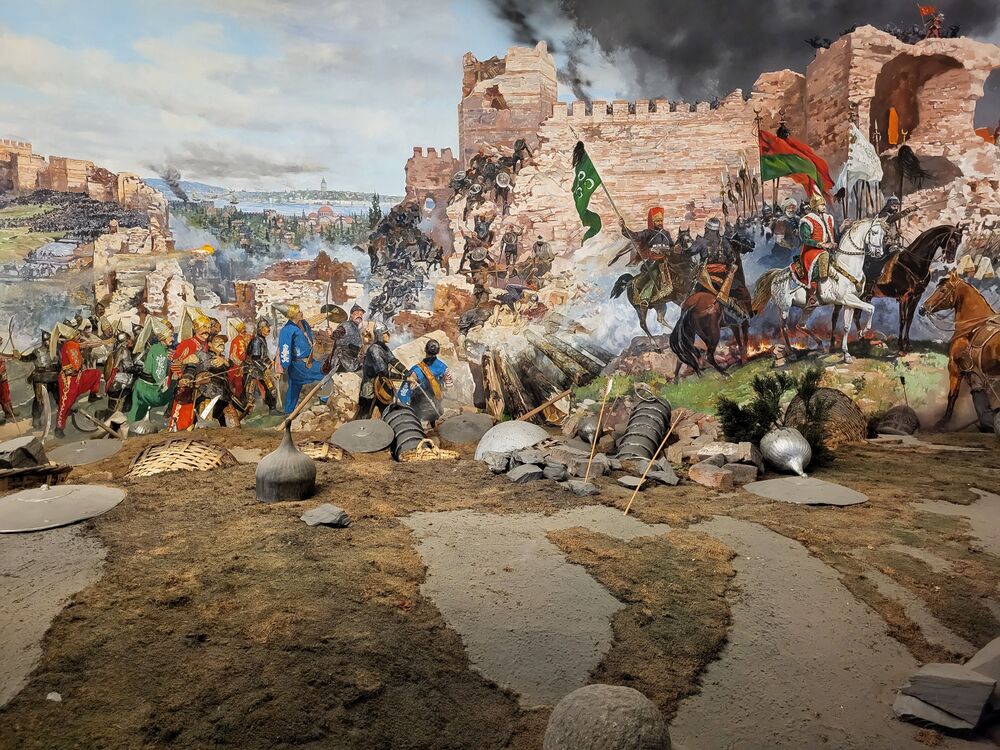
Final assault and the fall of Constantinople in 1453. Captured by Mehmet. Diorama in Askeri Museum, Istanbul, Turkey.
As new territories were annexed, the population under control rapidly multiplied, the pool of conscripts expanded, and tax revenues increased[256] . Moreover, Moscow now controlled the river and overland trade routes from Asia to Europe that ran through the lands of North-Eastern Rus'[257] . Moscow transformed into one of the largest centers of trade in Eastern Europe[258] . Government revenues increased. The influx of silver and furs into the Grand Prince’s coffers not only made it possible to build up military forces[259] but also attracted a growing number of European scholars, craftsmen, and military experts, especially artillerymen, who offered their services[260] .
The disparity in military power between Muscovy and the feuding Turkic khanates and hordes was rapidly growing. Not only did its prestige grow in their eyes, but the Grand Prince was also perceived as one of the successors of the Golden Horde’s rulers[261] . From the 1500s onward, “letters from Crimeans and Nogais to Moscow… opened with the words ‘To the Great Ulus’s Grand Prince’ (the same term was included in the full title of the Crimean Khan), that is, the post-Horde khans now applied the concept of ‘the Great Ulus,’ which had previously served as the official name of the Golden Horde, to Muscovite Rus'[262] .” In 1519, Grand Prince Vasily III, the father of the notorious Ivan the Terrible, appointed his own protégé[263] as the ruler of the Kazan Khanate for the first time. When this puppet ruler was deposed in an uprising, Moscow sent large military contingents to Kazan three times in 1523–1524 and 1530[264] . “Russian voivodes [military commanders] almost captured the cities, but yielded to the pleas of the Kazan people, who promised complete obedience to the Grand Prince[265] .” During the same period, the ruling and clerical circles of Muscovy first explored the feasibility of annexing the entire Kazan Khanate, and preparations began[266] .
Amid these dramatic changes occurring in the late 15th and early 16th centuries, the international status of Muscovy[267] increased significantly. Foreign ties intensified[268] . Europeans, who vaguely imagined Russia as a very harsh and extremely cold barbaric country, increasingly made their way to Moscow[269] . Upon closer acquaintance though, the Germans, Dutch, and English still did not recognize Muscovy as a civilized state[270] . For them, Europe ended somewhere on the outskirts of Riga and Reval (now Tallinn). By contrast, this was a “vile, servile land,” where “save for the tsar, everyone is a kholop” [a serf], even members of the hereditary nobility, much to the surprise of Europeans (in European states, the aristocracy, self-governing urban communities, and the church limited the power of the central authority, making despotic rule impossible[271] ). “Russian people are in great fear and obedience…; they humbly beg to be allowed to serve the Grand Prince…[272] ,” noted an English traveler who visited Moscow in 1553. His compatriot, who traveled there four years later, added in his narration about the Russian monarch: “He keeps his people under strict control.[273] ”The Austrian diplomat Sigismund von Herberstein, the founder of Russian studies in Western Europe, who visited Muscovy twice, noted a particular “tyranny of the sovereign.” According to him, “in his power over his subjects, both secular and clerical ones, Vasily, [the Prince of Moscow], surpassed all other monarchs… His subjects see him as the executor of God’s will…[274] ” This “tyranny of the sovereign” reached a truly unprecedented scale under the son of Vasily III, who went down in history as Ivan IV the Terrible.
The Eastern Foundations of Russian Authoritarianism
In the 14th–16th centuries, including a long period under the patronage of Uzbeg Khan and his son, Moscow’s ruling and clerical elites succeeded in creating an optimal model of governance for the emerging Eurasian empire. They harmoniously blended[275] the legacy of the Orthodox great-power ideology[276] of Byzantium with the Golden Horde’s administrative model, which combined various elements of Muslim, Chinese[277] , and Mongol governance systems[278] . Such were the origins of the Russian concept of statehood. While the Orthodox component largely faded over time, especially during the Soviet period, the principles originating in the Golden Horde have remained unshakable for 500 years now. The most fundamental of them are as follows:
- Sacralization of power is the ideological basis for legitimizing power in the Mongol Empire, the Golden Horde, and Muscovy. Mongols inherited this tradition from the preexisting East Eurasian empires of the Huns and ancient Turkic peoples.[279] According to their shared vision, the supreme ruler who was “akin to Heaven” was “installed by Heaven” and “bestowed with” power and the state.[280] As Islam became the dominant religion under Uzbeg, “the khan was authorized to rule in the name of Allah”.[281] From the second half of the 14th century onward, the Golden Horde’s political culture was characterized by the “ belief in the ruler’s divine charisma… by virtue of which he served as a mediator between God and the people”.[282] The idea of the Moscow monarchy, first articulated in 1480, was justified using Turkic methods of sacralization, albeit by contrasting the Russian sovereign with the “false” Tatar “tsar.”[283] On the one hand, the Grand Prince of Moscow was proclaimed the “shepherd” of the Orthodox Russian people[284] ; on the other, he was hailed as the “God-ordained tsar”.[285] In 1547, the same means of legitimation were applied to the first “God-crowned tsar”[286] of Muscovy, Ivan the Terrible. Official chronicles emphasized that he “ consulted with no one but acted by the inspiration of Divine Providence”.[287] In the early 1560s, the Metropolitan specifically proclaimed him as the “God-given…, and pious, and God-crowned tsar”.[288] In this manner, Moscow ideologists reframed[289] Turkic-Mongol and Golden Horde-Islamic concepts of power sacralization using Orthodox phraseology.
- The absolute despotic power of the supreme ruler modeled after the khans’ despotism[290] “restrained by nothing”. The founder of the Mongol-Tatar Empire, drawing on the Chinese tradition of autocracy[291] , “concentrated in his own hands[292] , and thus in the state he had created, all the powers that had previously belonged to the tribes.” Muscovite rulers did the same as they subjugated the remaining principalities of North-Eastern Rus'. “The transition to a despotic central authority[293] , linked to the Eastern model prevalent in the Jochid state, contributed to the strengthening of the Russian princes and, ultimately, the strongest of them—the Prince of Moscow.” Ivan the Terrible provided theological justification[294] for unlimited monarchical power.
- The ruler’s reliance on the use of force[295] to control his subjects and pursue expansion. This component formed the backbone[295] of the Mongol governance system, which built on the experience and the special role of the military and administrative apparatus in the Chinese imperial tradition[296] . “…Thanks to the Jochids, the Moscow princes gained a monopoly on using violence in their own society”. This “laid the groundwork for the centralization of power and made the emergence of a centralized state possible.[297] Since the monopoly on violence in the Principality of Moscow developed by drawing on the practices of the Jochid state, it was despotic in nature[297] , reflecting the patterns typical of Eastern centralized states”. During the late 15th and early 16th centuries, as the Tatar nobility and their military contingents entered the service of Ivan the Terrible’s grandfather, the Principality of Moscow adopted the practice of ruthlessly suppressing internal opposition[298] . Hence the “rapidly escalating claims to a broad freedom in the exercise of power, and a complete freedom from the traditional, usually law based framework governing the princely rule…” That is why one of the first measures that Ivan the Terrible took after the establishment of the monarchy was to form special troops[299] . On this foundation, the infamous Oprichnina emerged—the tsar’s personal guard tasked with implementing a policy of repression and punishment. Even the concept of violently suppressing the opposition and potentially disloyal figures rested on the sacralization of power and was to reinforce it by instilling religious fear among the subjects: “…through the Oprichnina, the tsar sought to recreate the image of the Last Judgment and, equating himself with God, he executed and granted mercy by his own judgment[300] ”.
- Rigid centralization of power (based on the Chinese model[301] , via the early Golden Horde’s mediation) enabling the concentration of material and human resources for the purposes of expansion against smaller and more fragmented neighbors, and the suppression of any attempts at popular self-government and autonomy of local elites. Before the Golden Horde, the power of Rus' princes “was strictly limited[302] by various forms of local self-government.” Princes ruled through compromises[303] with their communities. However, with the aid of the Golden Horde khans[304] , Moscow was able to rid itself of these remnants of tribal Slavic democracy. “ The unification of Great Russia was accomplished by dismantling all local, independent political forces in favor of the sole authority of the Grand Prince”.[305] As Nikolay Karamzin, one of the founders of Russian historical science, observed in this regard, “The internal governance framework changed: everything that resembled freedom and ancient civil rights was constrained and vanished…”[306] Moreover, “The Russian rulers borrowed[307] from the Horde some elements of the central executive government, and the principles of its formation, structure, and functions”.
- The supremacy of the sovereign and his protégés over written laws—the perennial source of abuse of power and bribery by officials, the latter documented in chronicles as “mzdoimstvo,” i.e., corruption (as noted above, it was considered standard practice for the Grand Princes of Moscow to look after their own interests, when collecting the “vykhod” [tribute] for the Golden Horde khans). “…Shocking cases of abuse occur… officials hide the truth”,[308] noted an English traveler who visited Moscow in 1553, taken aback by Russian ways.
- Unquestioning subordination of the church to the state, which applied both to Orthodox and Muslim clergy, limited tolerance toward people of other faiths, especially Muslims, in exchange for complete loyalty. In 1563, Ivan the Terrible remarked: “Many people of the Muslim faith serve in our land, too, and they live according to their own law[309] ”. Seven years later, Muscovy’s envoy in Istanbul explained to the sultan: “Those Kazan people who serve our sovereign faithfully still live on the sovereign’s pay in their own places, and the sovereign neither turns them from their faith nor destroys their places of worship[310] ”. In this respect, the first Russian tsar effectively replicated[311] the religious policy of Chinese origin practiced by the Mongol-Tatar khans[312] , in particular Uzbeg[313] .
- The imperial drive for territorial expansion—waging wars of conquest was one of the three main functions[314] of the supreme ruler according to the Mongol doctrine of state power. From the coronation of Ivan the Terrible onward, the power of the Muscovite tsar came to be measured by the number of conquered countries and the scale of conquest[315] .
The Emergence of the First “Tsar of All Rus'” and the Turkic Roots of His Legitimation
An event that had no precedents in Russian history marked the period when the core components of the statehood concept were developed and first implemented. In 1547, the Grand Prince of Moscow Ivan IV (the Terrible) became the first Tsar of all Rus'.[316] Neither his father nor his grandfather had dared to assume this title[317] . Moscow became the seat of the tsar.[318]
The official chronicle portrayed this event as “the beginning of a new era in the history of the world”.[319] Yet, apart from the court servants and the high nobility, the common people of Muscovy did not notice this landmark development, nor did foreign rulers recognize it at first.[320]
In 1549, the envoys of the King of Poland and the Grand Duke of Lithuania flatly refused to accept documents from Ivan IV signed with the new title of tsar, “saying that this had never happened before”.[321] The young monarch petulantly demanded that his close aides immediately move troops against Lithuania so that at least this western neighbor would recognize his new title and special status[322] .
Why special? The term “tsar” is a Slavic calque of “caesar” of the Roman and Byzantine empires; however, Russian chronicles primarily applied it to the Golden Horde khans[323] . In the Russian tradition, “the fearsome title of the tsar” had meant “hitherto predominantly Tatar khans, supreme rulers, to whom our princes had bowed[324] ,” explained Sergey Solovyov, one of the most prominent Russian historians. Given this Golden Horde legacy, the adoption of such a title clearly reflected Ivan IV’s aspiration to establish a great power in the future. Of an even greater significance is the fact that, before the first coronation in Moscow, only the khans of the most important Turkic states that emerged on the ruins of the Golden Horde (the Kazan, Crimean, and Astrakhan Khanates[325] ) and the rulers of four large empires had held the same title and a truly regal status. Three of them were rulers of Muslim states—the Ottoman Sultan, the Shah of Persia, and the Shaybanids, rulers of Turkestan. Thus, the 17-year-old Grand Prince of Muscovy, having arbitrarily appropriated such a significant title, immediately “rose” above the “impious kings[326] ” of almost all of Europe[327] , identified his “competitors” in the East[328] , and asserted his claim to the Golden Horde’s legacy[329] . The first Russian tsar even demonstrated visually that he was a successor of both the Byzantine monarchs and the Jochids: according to an English traveler, the tsar’s tent was covered with gold brocade[329] , just like the khan’s yurt—the symbol of the Golden Horde’s power.
To some extent, owing to his lineage, Ivan IV’s ambitions were justified. His paternal grandmother[330] descended from the last Byzantine imperial dynasty[331] (which, incidentally, actively interacted with the Golden Horde[332] ), and on his mother’s side, he supposedly[333] had common ancestors with Genghis Khan himself[334] and was a descendant[335] of the Golden Horde usurper Mamai[336] . Turkic allies and puppets of Moscow obsequiously called Ivan IV “the White Padishah” and claimed he was a descendant of Genghis Khan himself.[337] Yet, apart from the outright sycophants who were dependent on the whims of the newly crowned monarch, few people took interest in and even fewer knew about such vague genealogical credentials.
So, what was to be done? The answer was simple enough: to use the newly born kingdom’s might, which had been accumulating since the time of Uzbeg, to absorb the remnants of the Golden Horde[338] . After all, the first Tsar of all Rus' had every right to make full use of his ancestors’ legacy, amassed under the aegis of the “Protector of Peace and Faith.” Both paternal and maternal ancestors of Ivan the Terrible, whether in Moscow (Ivan Kalita and his sons) or in the “white tent” of the Horde[339] , had faithfully served Uzbeg Khan.
In August 1552, a 150,000-strong[340] Russian force, which included Lithuanian, German, and Italian military experts[341] , led by the tsar, approached Kazan. On October 2, Kazan fell.[342] According to Ivan IV himself, Kazan residents were “slaughtered mercilessly like pigs, and their blood flowed through the streets”.[343] He observed that “countless lay dead… rivers of their blood flowed throughout the city, and streams of burning tears ran… horses and men waded in blood up to their knees”.[344] The tsar ordered to count those killed: “all in all, more than 190,000 Kazan people were killed, small and big, old and young, male and female” (the Russian troops lost 15,355 men).[345] A chronicler of the time added: “The whole city burned down…”[346] According to the chronicles, “So many were killed that there was nowhere in the whole city where one could step without treading on a corpse; and next to the tsar’s court and in the nearby streets, piles of the dead rose as high as the city walls; the moats were filled with them…”[347] Notably, during the battles for the city, quite a few natives of Shamakhi (today’s Azerbaijan) and Armenians[348] remained there.
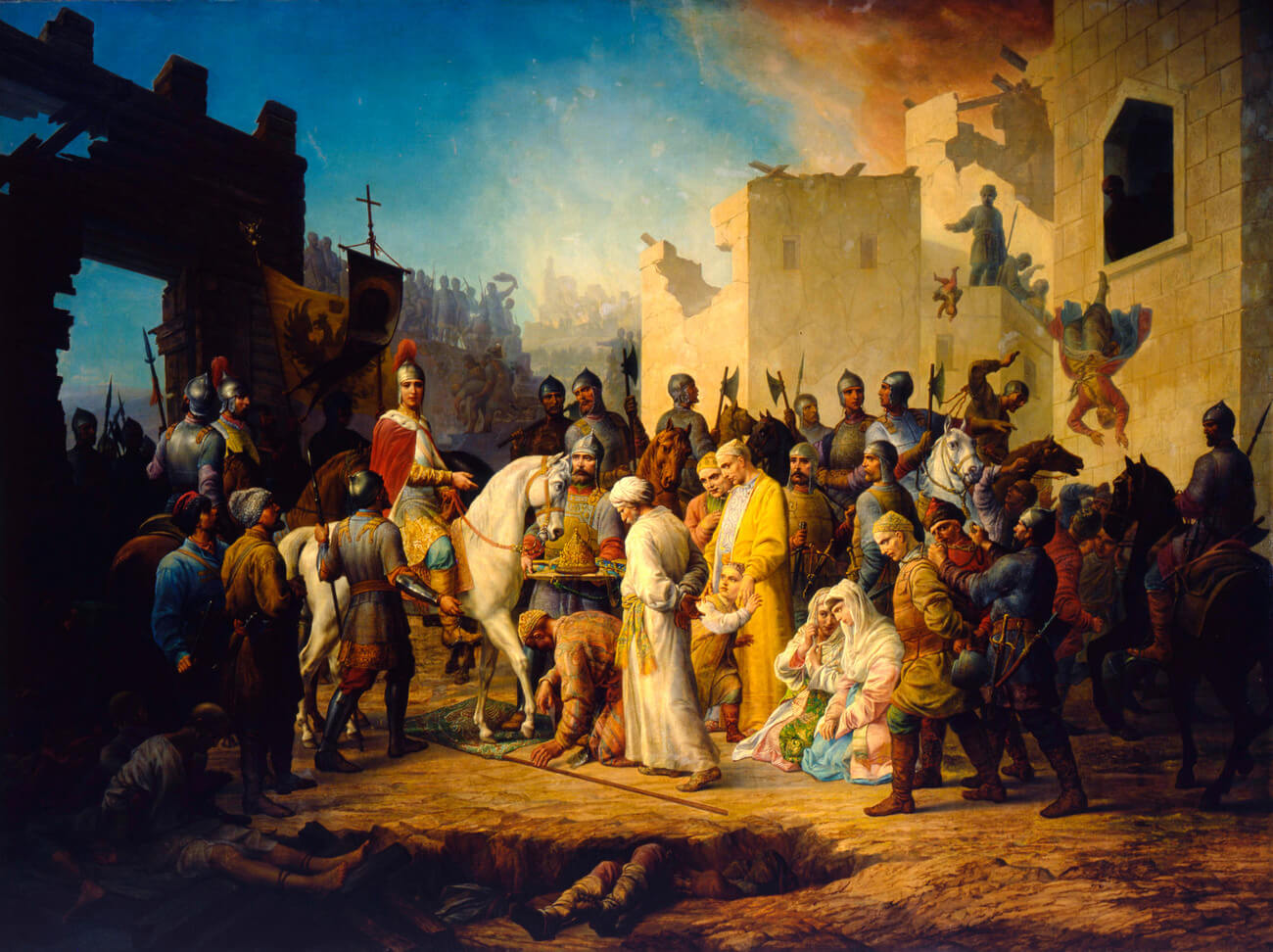
Capture of Kazan by Tsar Ivan IV on October 2nd 1552, by P. Shamshin, 1894.
Such grand and lavish festivities had never been and would never be seen throughout Rus', especially in Moscow.[349] That was the only occasion when Ivan IV, who now also assumed the title “Tsar of Kazan,” appeared before the public “clad in the full tsar’s regalia… in golden and silver attire, with a golden crown upon his head adorned with great pearls and precious stones, and the tsar’s purple mantle upon his shoulders”.[350] It was only then that the common people recognized him as the true tsar.[351] “Ivan, as the conqueror of an entire Tatar kingdom, became a hero in the eyes of the Russian people, and they glorified him in their songs”.[352] Another four years later, in 1556[353] , Russian forces took the Tatar city of Astrakhan (Hajji Tarkhan),[354] located in the Volga River delta, where it reaches the Caspian Sea[355] . “It was the subjugation of the Tatar states in the Volga region and Siberia that was seen in Russia as the starting point of Ivan IV’s journey to gaining the tsar’s dignity”…[356] Accordingly, Russian diplomacy hastened to announce in European capitals that, from then on, Ivan IV was a true tsar—not only of Muscovy, but also of Kazan and Astrakhan—and everyone was expected[357] to recognize him as such, for “Kazan and Astrakhan have belonged to the tsar from time immemorial[358] ”. The Moscow envoy dispatched to the Polish king in 1553 was instructed[359] that when asked “Why does Ivan call himself ‘tsar’?”, he should reply as follows: “Because he, Ivan, has seized the Kazan Khanate.” Even more than a century later, in 1667, Russian envoys in Spain justified the legitimacy of the Moscow monarchy by citing its subjugation of the Kazan and Astrakhan Khanates[360] . At the same time, a former Russian diplomat who had defected to Sweden wrote that only after the conquest of Kazan and Astrakhan “did he, the Grand Prince, establish himself as the ruler of the Moscow state and those conquered kingdoms… and in such a manner tsardom was established in the Russian land”.[361]
Ivan the Terrible extensively borrowed the practices of the Golden Horde and imitated that empire[362] , thereby reinforcing the idea that Muscovy’s monarchy derived its legitimacy from the conquest of the Kazan and Astrakhan Khanates—two of the three primary Turkic successors to the Golden Horde. It was not just about the above-mentioned golden tent. Muscovy replicated the practices of the great khans in administration and taxation. It was in the 16th century that massive integration of Turkic administrative and military vocabulary[363] into the Russian language began. Even the tsar himself used Turkic loanwords[364] in his writings. Meanwhile, members of the Tatar nobility soon made up about 20 percent[365] of the service class in the Tsardom of Moscow. After the death of Ivan the Terrible, the total number of Tatars in tsar’s service reached approximately 50,000[366] . They actively contributed to the replication of the Golden Horde’s practices in the process of creation of the new Eurasian empire.
One of the most striking examples of this continuity was Ivan the Terrible’s obsessive drive to subjugate former territories of the Golden Horde. Moscow explicitly positioned itself on these territories as the Horde’s successor[367] . It is no coincidence that, from the time of this monarch onward, eastward and southward expansion became unstoppable. The Tsardom of Moscow and later the Russian Empire continued to reproduce the Golden Horde’s strategy[368] even in eastern Caucasus. This manifested in its persistent desire to secure a foothold in what is now Azerbaijan and in occasional invasions from there into northern Iran, without any real effort to establish its presence there.
It was far easier for Russia to expand its territories by conquering its weakened and fragmented Turkic-Muslim neighbors than to engage in exhausting, protracted wars[369] with the technologically superior West[370] . By the end of the 19th century, approximately 90 percent of the former lands of the Golden Horde had been absorbed by Russian expansion.
The Intensification of Imperial Expansion into the Muslim East
As shown above, Moscow’s expansion into the Muslim East began amid a deep crisis in the Golden Horde, in the 1370s. From that time until the 19th century, building fortresses and defensive lines[371] on the frontiers of territories where Russians lived or deep within Muslim lands served as the principal instrument of expansion. Such fortifications protected Slavic colonists and functioned as outposts for further territorial acquisitions.
In the 1390s, princes of Moscow began occasionally seizing the former lands of the disintegrating Golden Horde empire. Until the 18th century, Moscow’s expansion into Muslim regions was largely limited to the former domains of the Golden Horde[372] or territories that had previously been within its sphere of influence.
Before the formation of the Tsardom of Moscow under Ivan the Terrible, this advance[373] was directed almost entirely eastward and northeastward—towards modern-day Mordovia, Chuvashia, Udmurtia, Mari El, Tatarstan, western piedmont of the Ural Mountains, and Western Siberia.
However, starting in 1549, soon after the coronation of its first tsar, Muscovy’s reach into the Muslim lands expanded significantly in terms of geography and became overtly imperialistic[374] . While previous Russian campaigns, besides material gain, were mostly aimed at expansion and consolidation of political influence, from 1549 onward the focus shifted to large-scale annexation of Muslim territories[375] . Moscow switched to seizing lands that “had not only previously belonged to the Golden Horde but also had constituted its ‘core’, its foundation[376] .” An English merchant who traveled to Moscow in 1557–1558 and was received by the Russian monarch remarked with admiration: “The tsar here is very powerful, for he has made many conquests…[377] ” In 1567, Ivan the Terrible emphasized in his address to the Polish–Lithuanian ruler that the Russian tsar was “the possessor of many lands and one who is ever adding to them[378] .” By the end of the 37-year reign of Ivan the Terrible, Muscovy’s area had increased from 2.8 million to 5.4 million square kilometers[379] . It became the largest state in Europe and now laid claim to[380] the lands of present-day Ukraine, Belarus, Moldova, Lithuania, Poland, Czech Republic, Romania, Hungary, and even Austria.
The capture of Kazan (1552) and the takeover of Astrakhan (1556[381] )—the capitals of the Turkic-Muslim khanates with the same names—were the major milestones in this transformation. The lands of the former gained importance as a base for the Russians’ advance to the east, into Siberia. As for Astrakhan, it traditionally gravitated toward the Caucasus[382] and was a major center of trade with Shemakha (present-day Azerbaijan), Persia, and Turkestan[383] since the Golden Horde times. Major players in international politics at the time and more recent researchers recognized it as a perfect outpost for expansion toward the Caucasus, including Shirvan (now Azerbaijan), Persia, and Central Asia[384] . Located in the northwestern coastal region of the Caspian Sea, in the late 16th century[385] Astrakhan turned into[386] Russia’s base for advancing deep into the Caucasus and an important hub for gathering intelligence about this region, including Erivan. “Astrakhan is the most distant fortress that the Russian tsar has conquered in the direction of the Caspian Sea;[387] he strives to make it very strong…”, noted an English merchant who traveled there in 1558.
After the subjugation of the Astrakhan Khanate, Moscow gained direct access to the Caucasus[388] . As early as in the 1550s, local petty tsars and nobles[389] increasingly made their way to the Russian monarch’s court. Overall, Muscovy significantly expanded its geographic reach and intensified its advance eastwards and southwards. This is evidenced by the following landmark events:
- 1554–1558: Muscovy subjugated most of Bashkiria[390] .
- 1559: Muscovites waged the first large-scale campaign against Crimea[391] .
- 1560: Muscovite forces, coming from the Caspian Sea, attacked the city of Tarki—the capital of the[392] Tarki Shamkhalate of the Kumyks (now lying within the administrative boundaries of Makhachkala, the capital of Dagestan).
- 1567:Russians built their first fortress in the Caucasus[393] , in what is now Chechnya.
- 1573: Russians suppressed a Tatar uprising in the Lower Volga region and definitively brought the region under their control[394] , including present-day Astrakhan and Volgograd Regions, southern Saratov Region, and western Kalmykia; they also seized the capital of another Turkic state, the Nogai Horde, in the west of today’s Kazakhstan.
- 1586–1598: Russians defeated the Khanate of Sibir (“the Tatars defended themselves desperately[395] ”), subjugated the local population, and began building fortresses and towns in Western Siberia[396] .
- 1586: marked the first time that the tsar of Muscovy accepted one of the rulers from the South Caucasus as his subject[397] – it was the ruler of Kakheti (Eastern Georgia)“, threatened by Ottomans on one side and by Persians on the other side[398] ”.
- 1591: Muscovite troops captured and burned[399] the city of Endirey in central Dagestan.
- 1593:[400] Muscovite forces briefly occupied Endirey and Tarki.
- 1604:[401] a ten-thousand-strong Muscovite army briefly captured Tarki, Endirey, and Karabudakhkent (Central Dagestan); units consisting of Ottomans and local highlanders advanced on them, forcing the Russians to retreat and killing most of them.
- 1632[402] : Muscovy declared that Yakutia, a territory twice the size of all of Western Europe, was now its possession.
- 1696: Russian troops captured Azov[403] , which had served as the most important Ottoman stronghold in the region north of the Black Sea for more than two centuries, providing access to several operational directions—Crimea, the Western Caucasus, and the Volga region.
The Beginning of Russian–Turkish Friendship–Confrontation
The rise of the Principality of Moscow in the late 15th and early 16th centuries led to an expansion of trade relations[404] and the establishment of diplomatic contacts with the Ottoman Empire[405] , which established a firm foothold on the northern coast of the Black Sea (including Crimea) in the 1470s–1480s[406] . Between 1522 and 1530, Muscovy’s diplomats seriously expected to establish an alliance with the Ottomans[407] . However, the imperialist expansion of the Tsardom of Moscow eastward and southward that began in 1549[408] predetermined their eventual conflict.
In 1549–1552, the Ottoman Empire, which by then had become the strongest military power in Europe[409] , attempted to form an anti-Moscow coalition with several Muslim states—remnants of the Golden Horde[410] . In 1552, in an attempt to thwart the Russian conquest of Kazan, Ottoman troops together with the Crimean Tatars attacked Tula[411] . Seven years later, when the tsar’s troops undertook the first major campaign against Crimea, they captured Turkish prisoners for the first time[412] . In 1569, a large Ottoman army invaded Muscovy in an attempt to liberate Astrakhan[413] . This episode is regarded as the first of 12 armed conflicts between Russia and the Ottoman Empire[414] during the 16th–20th centuries[415] (the failure of the Astrakhan expedition prompted the Ottoman Empire to seize the eastern part of South Caucasus[415] ). In 1571[416] , by order of the Sultan, a united army of 100,000 Crimean Tatars, Turks, and mountain dwellers from North Caucasus descended upon Moscow. The city sustained great damage. A year later, a repeat campaign[417] was organized. But this time the Russians won[418] , and anti-Turkish forces within the Ottoman Empire and the countries under its control increasingly gravitated toward Muscovy.
After the ruler of Orthodox Kakheti (Eastern Georgia) was accepted as a Russian subject in 1586, the monarchs of Muscovy added the following honorifics to their title: “Sovereign of the Iverian Land, the Georgian Tsars and the Kabardian Lands, the Cherkasy and Mountainous Princes[419] .” Although they still did not have the strength to conquer the Caucasus, Russian rulers clearly signaled their ambition to expand in the future. During the 17th century, Moscow regularly exchanged diplomatic missions with the Georgian kings, and the latter regularly requested protection from Persia and the Ottoman Empire[420] ; thus, which made a clash with these powers in the Caucasus only a matter of time[421] .