
Legacy of Ivan the Terrible and Peter the Great: “Exterminate Infidels—Multiply Christians” (1552–1827)

“…Make efforts to call on Armenians and other Christians to settle in Persian provinces occupied by Russian troops…, receive them warmly and otherwise keep them in every favor and protection…; and those among the Mohammedans who have shown any hostility, or are under suspicion, are to be expelled, and their lands are to be occupied by those Christians”[539] (from a decree issued by the Russian monarch Peter I, 1724).
Armenians assisted Russian monarchs in their advance into the Muslim East from the time of Ivan the Terrible. In the 18th century, Peter the Great relied on them in his conquest of the Caucasus. He put forward the idea of settling Armenians in the occupied Muslim territories and deporting the non-Christian population. In the 19th–20th centuries, his plan was fully implemented on the lands of the Turkic peoples, in Erivan and Zangezur.
- Ivan the Terrible and Peter the Great were the architects of the strategic partnership between Russia and the Armenian elites that continued until 2020.
- The view of Erivan as Russia’s base against Iran and Turkey became entrenched among the Russian leadership from the time of Peter the Great.
- In the 19th–20th centuries, Armenians from outside present-day Armenia were settled in the lands that are now Armenia, and hundreds of thousands of Muslims were expelled and deported, including by Stalin, who followed the model established by Peter the Great and Catherine II.
Ivan the Terrible: The Origins of Pro-Armenian Policy
Moscow’s increasing involvement in Eastern affairs from the second half of the 16th century onward, and the emerging regional rivalry with Istanbul predetermined the Russian tsars’ reliance on Armenians in their Caucasian policy. From the early 15th century, Armenians had a permanent colony in Moscow[540] . Russian merchants regarded them as their key intermediaries and partners in the Muslim East[541] . It is no coincidence that Armenians actively contributed to Muscovy’s first major territorial conquests in the Turkic-Muslim world.
Later, an Armenian historian noted with pride: “…Armenians helped Ivan the Terrible during the capture of Kazan [1552], indicating to the Russians the weak points in the defense of the city [the capital of the Turkic-Muslim Kazan Khanate]. According to a Kazan chronicler, Ivan the Terrible, who was aware of the Armenians’ favorable attitude toward Russians, ‘showed them great favor.’”[542] The same happened again four years later when Russian troops took the capital of the Astrakhan Khanate[543] .
With the annexation of the Kazan and Astrakhan Khanates in the 1550s, Muscovy gained control of the local Armenian colonies[544] that had expanded during the Golden Horde period[545] (due to the growing trade, especially under Uzbeg Khan) and had extensive connections in the Caucasus, Persia, and the Ottoman Empire.
Starting in 1677–1678[546] , the Armenian clergy and nobility from the western borderlands of present-day Armenia, then part of Persia, began to lean towards Russia.
How Peter the Great Followed in the Footsteps of Ivan the Terrible: Despotism, Expansion, and Armenian Affairs
When the famous monarch Peter I undertook hisfirst large-scale advance into the Caucasus[547] in the early 18th century the,partnership with the Armenians was renewed and deepened rapidly[548] .
The young, headstrong Tsar, who came to power in 1682 and went down in history as Peter the Great, transformed the medieval Tsardom of Moscow into the Russian Empire that was relatively modernized by the standards of the time (1721). Peter's reforms transformed the archaic and semi-Oriental Muscovy that had been shaped by centuries of Tatar and Byzantine influence into an outwardly “Europeanized” superpower. It became the dominant force in Central Eurasia[549] . The West was now forced to reckon with it. In the centuries that followed, liberal Russian intellectuals idolized Peter I for supposedly opening the “window to Europe” for Russia. In reality, his reforms and borrowings from Europeans focused on strengthening the autocratic, despotic system of his empire, Eurasian in spirit, and enhancing its capabilities for external expansion. The massive modernization of the state machinery by bringing in Western experts, technologies, and governance methods enabled Peter I to significantly build upon Ivan the Terrible’s achievements in establishing an administrative and policing apparatus and expanding territorial conquests[550] .
This “discoverer of Europe” continued the work that the first tsar of Muscovy started, but now “in a modern way,” using technology and on an even larger scale. Peter I was as focused on expansion into the Muslim East as Ivan the Terrible had been. He also made full use of the groundwork laid by his renowned predecessor. It was in the times of Peter the Great that Astrakhan, annexed by Ivan the Terrible, acquired full significance as a strategic base for advancing into the Caucasus, Anatolia, and Turkestan. Peter I inherited from Ivan the Terrible the early blueprints of geopolitical rivalry with the Ottoman Empire and achieved the first tangible result in terms of gaining new territories by capturing Azov, the most important Turkish stronghold, and neighboring lands in the northern Black Sea region)[551] . He also made use of the great-power ideology of eastward expansion, which had been refined under Ivan the Terrible, and in 1711, scaled up this concept by declaring that his goal was “to liberate the local Christian peoples from the pagan [Muslim] tyranny, to adorn Orthodox churches there, and to exalt the Life-Giving Cross[552] .” Both in the Petrine era and under Ivan the Terrible, “Moscow emphasized its succession from the Mongol [Golden Horde] state[553] ” in order to assert Russian dominance over Turkic peoples.
Although Peter I failed to achieve any long-term practical results through his expansionist endeavors in Turkestan[554] , the Caucasus, and Anatolia, his reign served as the bridge between the rule of Ivan the Terrible and the offensive policy of the Russian Empire in these regions in the second half of the 18th century and the early 20th century.
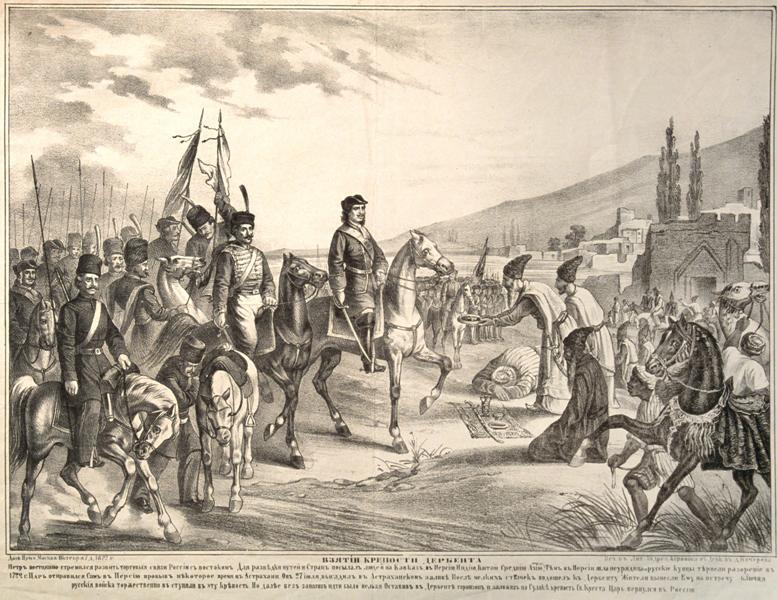
Persian (Caspian) Campaign of Peter I. Entrance of Peter the Great in Derbent, 1722.
The Armenian Legacy of Peter the Great
Ivan the Terrible extended “great favor”[555] to Armenians and relied on their support in his expansionist policy in the Muslim East, and Peter I embraced and significantly developed this heritage. It was Peter’s decrees that provided the basis[556] for the systematic settlement of Persian Armenians on the lands of the Astrakhan Khanate annexed by Ivan the Terrible. Whereas Armenians actively helped in the conquest of Kazan under the first Tsar of Muscovy, the “discoverer of Europe” consolidated and scaled up their role as agents of Russian policy “against pagan tyranny”[557] throughout the Caucasus.
As Grigor Chalkhushyan, an Armenian public figure, later wrote with admiration, “beginning with the most glorious era of the genius reformer Peter the Great, the name of the patron of Christians in the East [meaning Russia] was firmly established[558] ”. Indeed, from the time of Peter I onward, Russian authorities extensively used Christian rhetoric to expand engagement with Persian and Turkish Armenians[559] . As Peter himself proclaimed, “By the grace of God we, Peter the First, Emperor and Autocrat of Russia… keep the honest Armenian people in our special favor for the sake of Christianity,[560] ”.
Armenians themselves citing their small numbers in the Caucasus[561] , especially in Erivan[562] , and regularly complaining to Russia about Muslims[563] , wrapped their repeated requests to dispatch Russian troops to aid them in Christian rhetoric[564] . The first appeal of Armenian nobility to Peter I, sent to Moscow in 1699, provides a typical example of such deliberate accommodation to the tenets of the great-power ideology. This appeal read: “For this reason, we ask, for the love of God, that Your Majesty be so kind as not to abandon us for long… May Christ the Savior grant strength to your army, which will aid us. We beg Your Majesty, weeping and wailing, to help us in our most dire need … We thank God a thousand [times] that, [as if] by the voice of the Holy Spirit, Your Majesty is so opposed to the infidels [Muslims] and caring toward Christians; we always suffer torment in the name of Jesus Christ, and await that Your Majesty help us… through Your Majesty we can be delivered [freed] from the yoke of the infidels, for the spread of the Christian faith.”[565] Concluding their letter, these subjects of the Persian Empire promised to serve the Russian tsar—that is, a foreign monarch—with their “life and wealth.”[566] Subsequent appeals by the Armenian clergy and nobility to the Russian authorities contained similar assurances. As a rule, they also expressed their willingness to provide every possible assistance, should the imperial troops be dispatched to the region[567] .
Thus, Peter I established the tradition of mutual support[568] between Russian rulers and Armenian leaders in the Caucasus that continued until 2020 with only brief interruptions. Under Peter’s successors on the throne, the authorities of the Russian Empire frequently appealed to Peter’s legacy[569] in their pro-Armenian policy, as did Armenian activists[570] , who sought all kinds of assistance, privileges, and benefits from the Russian authorities.
Peter’s Plan to Change the Ethnodemographic Map of South Caucasus
Peter the Great was the architect of a grand project aimed at changing the ethnodemographic map of South Caucasus through the systematic, large-scale resettlement of Armenians from the neighboring regions of Persia and the Ottoman Empire. The succeeding Russian monarchs and Soviet leaders, especially Stalin, diligently implemented Peter’s design, scaling it up and adapting it to evolving realities.
Alexander Khudobashev, an Armenian writer and an official at the Russian Ministry of Foreign Affairs, wrote in the 19th century: “In his decree of March 2, 1711, Peter the Great ordered his Senate to grant protection to Persian Armenians and provide them with all possible benefits to draw them to Russia. Another order dated January 28, 1717, opened Russia’s doors to Armenians living in Turkey.” According to the same author, “In the days of Peter the Great, many thousands of Armenians left Persia, Poland, and Turkey, and resettled in Russia.”[571]
In October 1722[572] , the Russian emperor ordered that the settlement of Armenians in Baku be actively encouraged, starting the next year.
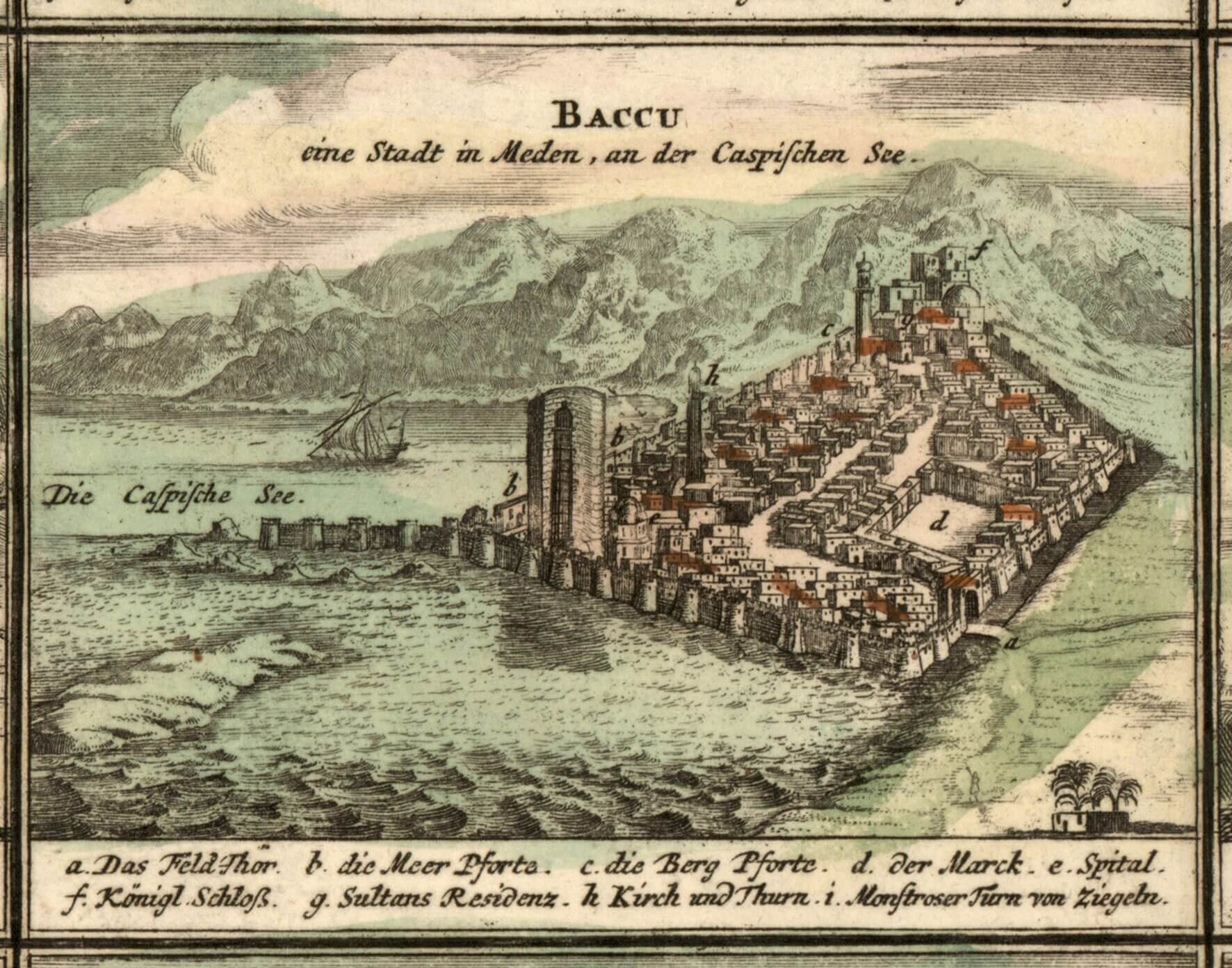
Baku. Old European engraving, 17th–18th centuries.
According to Peter Butkov, a member of the Russian government who drew on many official documents in his landmark historical treatise, in 1723, representatives of the Armenian nobility in South Caucasus “sent a diplomatic mission to Peter the Great, placing themselves under his protection and asking for reinforcement [support] to exterminate the infidels [Muslims].”[573] It was then that the idea emerged to deport the Muslim population from the lands conquered by Russia with a view to populating them with Armenians. In May 1724, Peter I ordered to settle Armenians in the regions conquered from Persia and “to reduce the Muslim population as much as possible”[574] .
Initially, it was envisioned that the grand project would primarily be implemented on the southwestern coast of the Caspian Sea (now northwestern Iran). In September 1724, Peter’s envoy to the Ottoman Empire was “instructed by the sovereign to persuade Armenians as much as possible to move to Gilan [occupied by Russian troops] and other territories under our control, and if they are many in number, then Persians will be moved elsewhere and they, Armenians, will be given the lands cleared of Persians.”[575] As soon as November 1724, new imperial decrees extended this scheme to other conquered territories in the Caucasus, including parts of what is now Azerbaijan[576] : “Forasmuch as [since] the Armenian people appealed to us that we take them under our protection and to order that suitable lands be granted to them for their settlement in our newly acquired Persian provinces… they are to be treated in such a way that no complaints whatsoever could be made by them, since we have taken the Armenian people into our special imperial favor and protection.” According to yet another decree, “…It is announced to all Armenian people that every effort shall be made to invite Armenians and other Christians to settle in the Persian provinces occupied by Russian troops: Gilan, Mazandaran, Baku, Derbent, and other suitable lands, to receive them kindly and otherwise keep them in every favor and protection; allocate to them lands convenient for their settlement in appropriate territories, and to give them those houses and property that stand empty in the towns and villages [because their Muslim owners had temporarily left their homes, fleeing hostilities]; also those among the Mohammedans [Muslims] who have shown any hostility [resistance to the Russian conquerors], or who are under any suspicion, are to be expelled, and their lands are to be occupied by those Christians [Armenian settlers].”[577]
Members of the Russian command received specific instructions to “invite for settlement[578] ” and “coax Armenians to resettle[579] .” Special emissaries were sent to territories beyond the Russian-occupied zone“ with orders to persuade Armenians to resettle in the Caspian regions[580] .” The imperial authorities on the ground, including in Baku and Salyan (in the east of modern Azerbaijan), were tasked with[581] providing Armenian resettlers with the best lands and all possible assistance.
Butkov provides the following explanation for these decrees: “one of Peter’s key ambitions” was “to increase the number of Christians in the acquired provinces.[582] ” Grigory Melgunov, a scholar specializing in Eastern studies who had himself served in South Caucasus for some time and had access to government archives[583] , emphasized that, alongside encouraging Armenian migration to the region, Peter I sought to “drive out Islam as much as possible.[584] ”Although the death of this outstanding Russian monarch prevented fulfilment of this intention at the time, his far-reaching plans to change the ethnodemographic map of the Caucasus were not forgotten.“ This idea of the great monarch and farsighted statesman — to win over Armenians in order to draw them to Russia — found strong support from all sovereigns in the centuries that followed,[585] ” observed Chalkhushyan.
Consolidation of Peter I’s Policy of Settling Armenians on Conquered Muslim Lands
Empresses Catherine I (1725–1727) and Catherine II[586] (1762–1796) continued Peter’s policy of resettling Armenians[587] into territories conquered from Muslims. “The Russian state became the protector and friend of Armenians. Russian tsars made big promises to Armenians, granted them privileges, and bestowed ranks and decorations in order to win their sympathies[588] ,” wrote Stephan Palasanyan, an Armenian philosopher and historian of the 19th century.
During Catherine II’s rule, Russia won major victories over the Ottomans. Notably, in 1783, it delivered the final blow to the Crimean Khanate[589] , the last Turkic successor to the Golden Horde[590] . Building on Peter’s policy, Russia secured its position on the northern coast of the Black Sea, conquered or subjugated vast territories of what is now southeastern Ukraine, including Crimea, and the adjacent areas of present-day southern Russia.
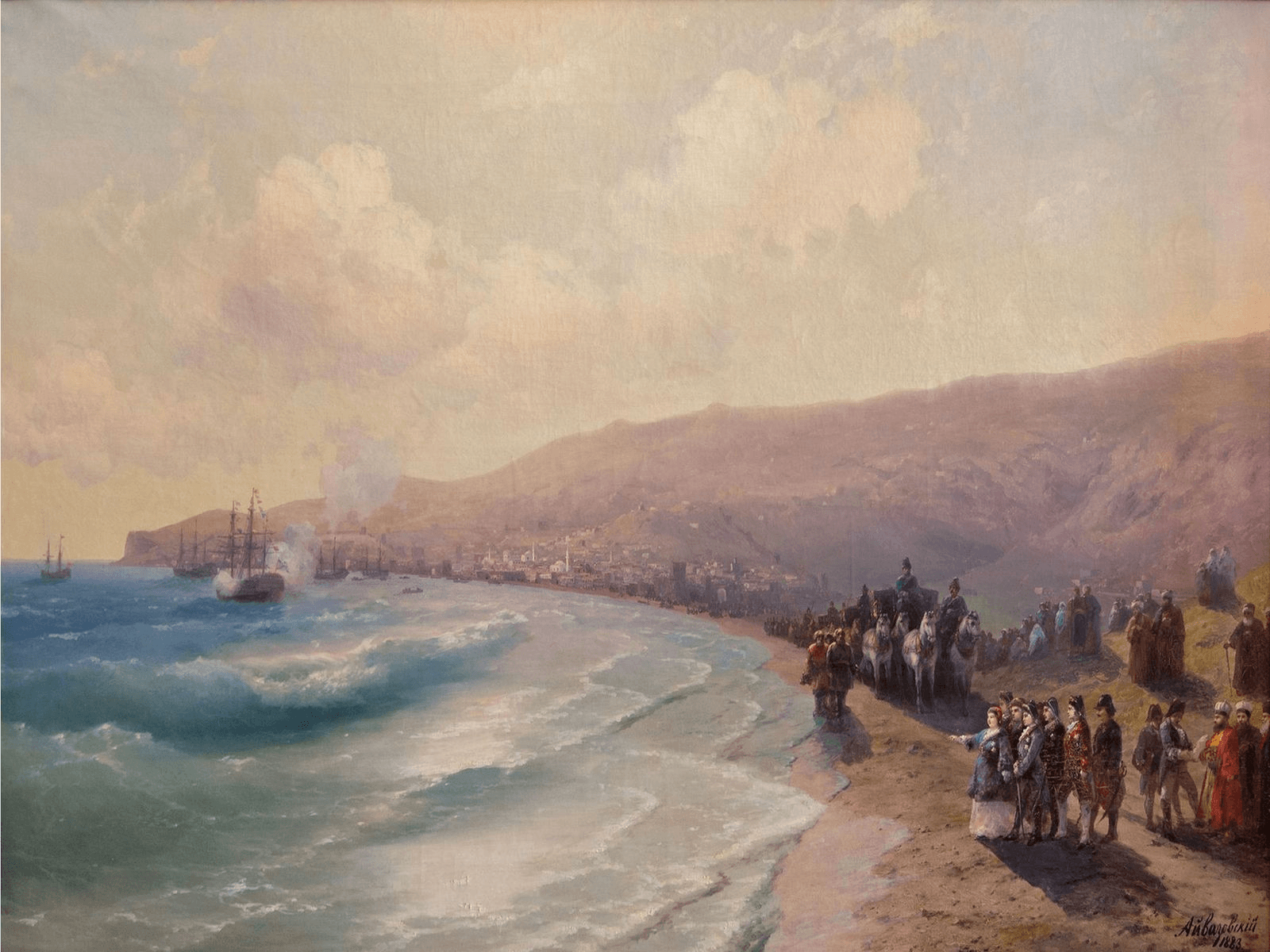
Arrival Catherine the Second to Pheodosiya, 1883 by I. Aivazovsky
For centuries, these lands had been populated or controlled by Turkic Muslims. Following the Russian conquest, large-scale resettlement of Armenians from abroad began[591] . This was aimed at increasing the Christian population, in line with the policy established by Peter I. At the same time, members of the Armenian clergy acting as Russian agents of influence made efforts to “instill an inclination to resettle in Russia among Armenians[592] .” The migrants received “a wide range of benefits[593] ” from the authorities. Chalkhushyan, the Armenian public figure whose writings were quoted above, remarked approvingly: “…Catherine the Great grants extensive benefits and advantages to the Armenian resettlers, and so, every success of Russian arms against Turkey or Persia brings a new influx of Armenians into Russia who are showered with favors and privileges.[594] ” Several decades later, this model of drawing in and offering material incentives to resettlers that Catherine II approved in 1779[595] and further refined in 1792[596] , formed the basis for organizing mass migration of Armenians to South Caucasus, particularly to the lands of the dissolved Erivan Khanate.
According to an Armenian researcher, “Catherine II’s policy in respect of Armenians living as Russian subjects was one of winning them over in order to persuade their ethnic kin in Persia and Turkey to resettle to Russia or at least to instill in them sympathies toward Russians.[597] ” Members of the Armenian nobility in South Caucasus wrote to the empress: “O most excellent Sovereign over all Christians in this world, your supreme power and unparalleled motherly grace have spread everywhere and shed their light upon our Armenian nation …[598] ” An early 20th century Russian researcher added: “Catherine II diligently takes care of Armenians and even dreams of establishing an independent Armenian kingdom in the East.[599] ”
Over the course of the 18th century, mainly Armenians from Persia (1711–1726)[602] , the Crimean Khanate (1778)[603] , and the rapidly shrinking Ottoman possessions in Eastern Europe[604] resettled in the lands conquered by Russia from the Muslims, including what is now eastern and southeastern Ukraine[605] and the former Astrakhan Khanate[606] . However, as Russo–Turkish military conflicts—there were as many as four in the 18th century— became increasingly frequent and the territories captured by Russia from the Ottoman Empire expanded, in 1793, Armenians from the interior regions of the Ottoman Empire, even from Istanbul itself, approached the Russian authorities[605] , seeking permission to settle “on the lands adjacent to the Black Sea.” In 1797–1798, more detailed plans were already being developed to resettle 60,000 Armenians from the eastern regions of the Ottoman Empire to Georgia[606] .
The Intensification of Russian Expansion in South Caucasus
“After the conquest of Crimea, Empress Catherine II turned her gaze toward Transcaucasia…[607] ,” noted Khudabashev. In 1780, the Russian leadership made the following decision regarding the Turkic-Muslim khanates in the eastern South Caucasus: “to pacify them by the force of our victorious arms[608] .” In the first half of the 1780s, against the backdrop of the dissolution of the Crimean Khanate and the establishment of a protectorate over Eastern Georgia[609] , “when Persian affairs, along with Turkish ones, took on special urgency for Russian diplomacy[610] ,” contacts between members of the Armenian nobility in South Caucasus and their ethnic kin in Russia, on the one side, and Russian officials, on the other side, markedly intensified. Joint actions were actively discussed.[611] Plans[612] “to form an Armenian province, not dependent on anyone but Russia.[613] ” were conceived. Projects were developed to use Armenians as the vanguard of Russian expansion[614] against Persia and the Ottoman Empire. Russia sent its agents to Armenians living in Persia-controlled areas of South Caucasus and in the northeastern regions of the Ottoman Empire, instructing them “to convey to them the idea of imperial patronage, by which they could be freed from the yoke of the Hagarenes.[615] ”
In September 1787, Russian troops, operating from Eastern Georgia, reached the territories of present-day Armenia for the first time[616] but were forced to retreat[617] .
A 100-Year Journey to Occupying Erivan
This story, too, began with Peter the Great. A prominent Armenian nobleman outlined[618] to the monarch the particular strategic importance of the well-fortified Erivan, situated between two Muslim empires—Persia and the Ottoman Empire. At the same time, Russian agents of Armenian origin began gathering[619] intelligence about this city and its environs. In 1716, emissaries from the “northern country[620] ” made first contact with members of the Armenian clergy in the westernmost part of what is now Armenia[621] . The latter reported that “the entire population of the Erivan region aspired to come under Russian protection[622] ,” begged to dispatch troops[623] , and promised them all kinds of support[624] .
During Peter I’s first attempt to seize Caucasian territories in 1722–1723, the first strategic plan to conquer Erivan also emerged: Georgians and Armenians from various parts of the region would lead the effort with Russian military support[625] . An Armenian cleric in Georgia, addressing a fellow Armenian and colleague who was also a Russian agent, clearly articulated the city’s significance for Armenian cause: “You know that Erivan is like a fortress in the Persian land, and our intention is only to take Erivan, and once it [this city] falls into our hands, neither the Ottomans nor the Persians will be able to do us any harm.”[626] However, the plan was thwarted[628] by the agreements that Russia and the Ottoman Empire reached soon thereafter[629] and the death of Peter I.
As the Russians advanced further into the Caucasus and regional rivalry with France and Britain[629] intensified, Russia was taking an increasingly keen interest in Erivan. In 1769, during yet another Russo–Turkish war, a group of Armenian leaders in Russia proposed to the Russian authorities that they should seize Erivan[630] and use it as a staging ground for advancing into Eastern Anatolia.
In the first half of the 1780s[631] , Russia’s interest in Erivan increased noticeably. Russian intelligence-gathering efforts[632] in the city intensified, with an active participation of Armenians.[633] Armenian agents based there also gathered[634] information in the heartland of the Ottoman Empire and Persia, and even in India. In addition, Armenians living in the west parts of present-day Armenia, including Erivan, established direct contact[635] with Russian leadership and urged[636] it to launch an intervention as soon as possible, “promising in turn to provide every possible kind of assistance and support to the Russian troops[637] .” They also tried to convince the Russian ruling elite that it would be “quite easy to take[638] ” Erivan.
In 1796, during the war with Persia, Russia undertook its second major attempt, since the time of Peter the Great, to subjugate the vast territories of South Caucasus[639] . And once again, just like at the time of Ivan the Terrible, Russians seized major Muslim centers with an active participation of Armenians. According to an official document, “Thanks to their assistance, Derbent was captured almost without bloodshed[640] ”. An Armenian archbishop[641] advised Commander of the expeditionary corps General Zubov on the realities of the Caucasus.
The main goal was to secure Russia’s position[642] in Eastern Georgia and Karabakh. The Russian military and political leadership also had the “intention” to seize the western regions of what is now Armenia[643] . They planned to “clear” the “Erivan region”[644] using Georgian forces allied with Russians. However, the local Armenian clergy and nobility expected the arrival of Russian troops and expressed their willingness to assist them in every possible way[645] . At the height of the hostilities, an Armenian who served as a major in the Russian army devised an operational plan for the “capture of the fortress of Erivan and the provinces adjacent to it[646] .” This plan emphasized the city’s particular strategic importance. The author assured General Zubov that once they took Erivan, “all of Azerbaijan would voluntarily submit and Georgia itself would be safe[646] [from Persia].” He proposed occupying the city through a combined effort of Georgian and Russian forces. However, this plan was not implemented: following the death of Empress Catherine II and the accession of the new tsar[647] , military operations ceased, and Russian troops left[648] South Caucasus.
Zubov’s campaign served as a prelude for the conquest of the entire region that followed soon thereafter. Having secured its position in Georgia in 1801–1804[649] and using[650] it as a staging ground, the Russian army made as many as three concerted attempts to capture Erivan (1804[651] , 1808[652] , 1827[653] ). Armenian units, formed primarily in Georgia, actively participated in all three on the Russian side[654] . During the final—and successful—assault[655] in September–October 1827, the then head of the Armenian Church led the invading force, “on horseback with a cross in hand[656] ”. “During the capture of Erivan… Armenians, spurred on by zeal and love, rushed to the Russian regiments and rendered every possible service,[657] ” observed a Russian historian four years later. During the siege of the city, “the Armenian population of Erivan rose up and demanded that [the last ruler of the Erivan Khanate] Gasan Khan surrender the fortress to the Russians. After Gasan Khan rejected the demand…, Armenians came toward the Russians through the breaches in the fortress walls and handed them the keys to the fortress.[658] ”
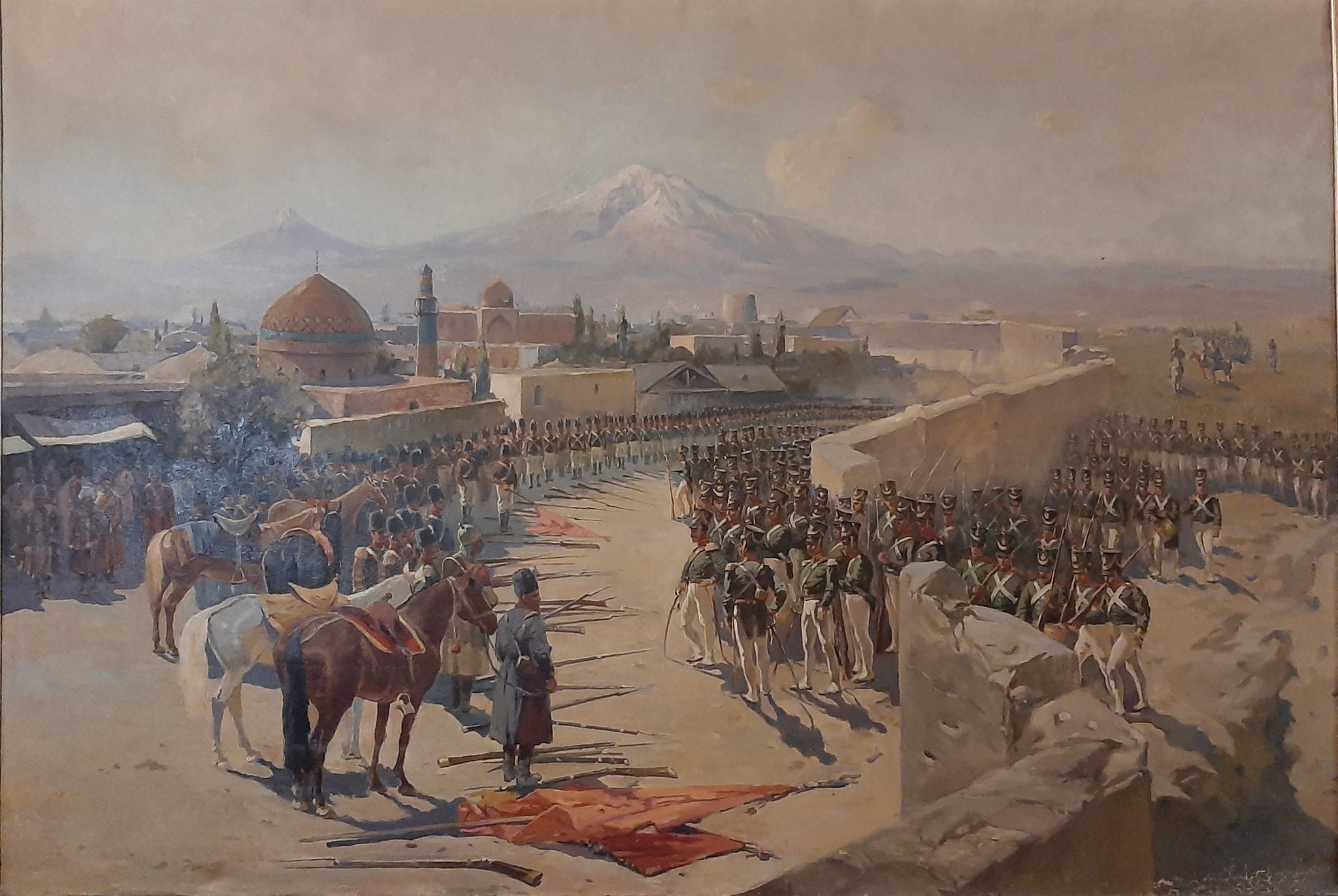
Capture of Erivan by Russian troops in 1827, by F. Roubaud.